Editorial guidance only. Product characteristics, care needs, and commercial terms should be confirmed in writing for any specific item.
Effective jewelry product descriptions help readers understand what an item is, how it may fit, and which details still need confirmation. Beautiful language can support that work, but it cannot replace evidence about materials, construction, or dimensions. For anyone learning how to write accurate jewelry product descriptions for retail, the central discipline is simple: separate documented facts from appearance, interpretation, and unanswered questions. This guide from katherine jewelry offers an editorial process for turning reliable information into useful copy. It also explains how to handle conceptual imagery without presenting a design illustration as verified merchandise or an available product.
Build a Verified Fact Record Before Writing
Before drafting jewelry product descriptions, create a working record with three fields: confirmed information, its source, and unresolved questions. Include metal composition, surface finish, stone identity, treatments, dimensions, fastening, and any supported production details. Keep supplier documents or written confirmations alongside the record. A missing answer is not an invitation to fill the space with familiar sales language; it is a question to resolve before publication or a detail to omit.
Appearance is particularly unreliable evidence. A silver-colored ring might have several possible constructions, while a clear stone cannot be identified from sparkle alone. Precise jewelry product descriptions therefore distinguish color from composition: “silver-toned” describes an appearance, whereas “sterling silver” identifies an alloy normally described as 92.5% silver. Use the latter only when supported. Likewise, surface plating is not the same as the named metal throughout, so disclose the construction rather than letting color imply substance.
Gemstone terminology deserves its own review. Natural, laboratory-created, and imitation are not interchangeable descriptions, and moissanite is a distinct material from diamond. Consult the FTC Jewelry Guides when checking how material identity, treatments, origin, durability, and value are represented. For jewelry product descriptions, the practical rule is to retain the distinctions documented by the source instead of replacing them with a more appealing but less accurate label.
Imagine a retailer receives a photograph and a supplier note reading only “gold necklace, white stones.” Neither establishes metal content, whether a coating is present, or what the stones are. Do not turn that note into confident jewelry product descriptions. Request written clarification, then compare the answers against the exact item reference. If the supplier cannot provide sufficient details, pause the listing rather than publish a material claim that shoppers may reasonably rely on.
Explore our product collection for individual designs, photographs, and product details. When considering jewelry product descriptions, look at each piece in the context of your own preferences and practical needs. Use the product description to check relevant specifications rather than relying on appearance alone. For a more personal recommendation or a question about a particular piece, contact katherine jewelry with the details that matter to you.
Translate Specifications into Useful Fit and Construction Details
Once the fact record is reliable, organize jewelry product descriptions around the decisions a reader must make. Lead with the item category and verified distinguishing features, then explain size, construction, and fastening. A poetic opening should not bury the necklace length or earring dimensions. Use consistent measurement units and identify what each measurement covers, because a technically correct number can still be misleading when its reference points are unclear or inconsistent.
For earrings, distinguish overall drop from the decorative element’s height, and specify whether a recorded weight refers to one earring or the pair. For necklaces, separate chain length, any documented extension, and pendant dimensions. For bracelets, clarify whether a figure describes internal circumference or end-to-end length. Useful jewelry product descriptions do not leave customers to infer these differences from photographs. A close-up can show detail beautifully without giving a dependable impression of scale.
Ring copy requires special care because fit depends on more than a size label. State the sizing system and any verified band-width measurement, then direct buyers to the relevant seller sizing table and professional fitting when needed. Avoid promising that a printable guide will produce an exact result. In jewelry product descriptions, “check the sizing table before choosing” is more responsible than claiming a universal fit, especially when a wider band changes how a ring feels.
Construction details should answer practical questions without pretending to predict every wearer’s experience. Identify a clasp or earring fastening only when confirmed, and do not call a piece lightweight without a defensible basis. For example, verified jewelry product descriptions might read: “The necklace measures [confirmed length], with a [confirmed fastening]. The pendant measures [confirmed dimensions].” Fill those placeholders from documentation, then add one concise design observation rather than unsupported promises about comfort or durability.
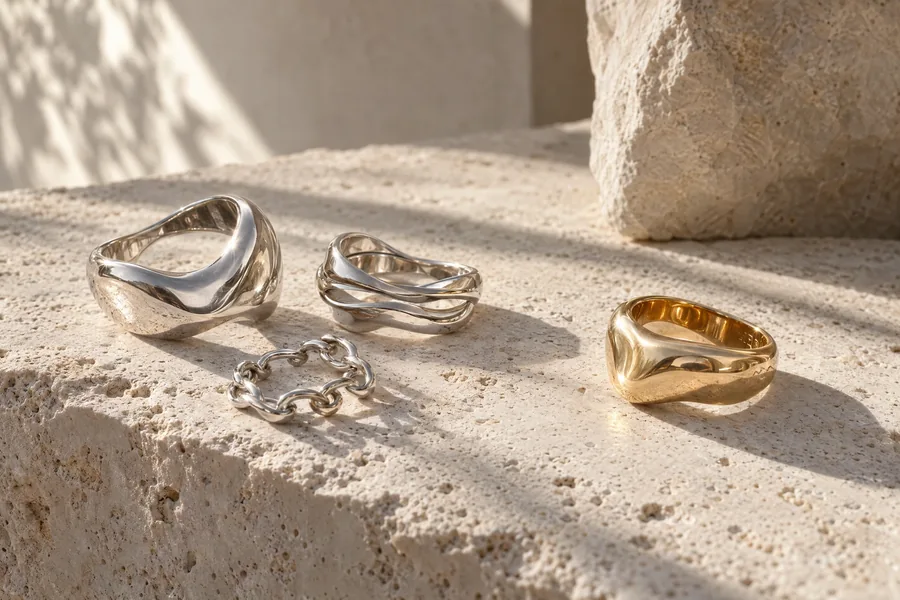
Design inspiration belongs in a separate layer from these specifications. A reader exploring earring concepts or ring design inspiration can consider proportions, shapes, and styling possibilities without assuming an illustrated piece is available. When adapting jewelry product descriptions to concept pages, explain that distinction plainly. “An elongated silhouette suggests a strong vertical accent” is an editorial interpretation; a stated weight, alloy, or fastening would require verified item information.
Make Images, Styling Language, and Care Advice Work Together
The relationship between copy and imagery can either clarify a page or create false expectations. Review jewelry product descriptions beside every image, not in isolation. Check whether a photograph or illustration makes the object appear larger, changes its apparent color, or shows details the text never explains. Gem color can appear different under different lighting and on different screens, so avoid guaranteeing an exact visual match based solely on a displayed image.
Explore our product collection for individual designs, photographs, and product details. When considering jewelry product descriptions, look at each piece in the context of your own preferences and practical needs. Use the product description to check relevant specifications rather than relying on appearance alone. For a more personal recommendation or a question about a particular piece, contact katherine jewelry with the details that matter to you.
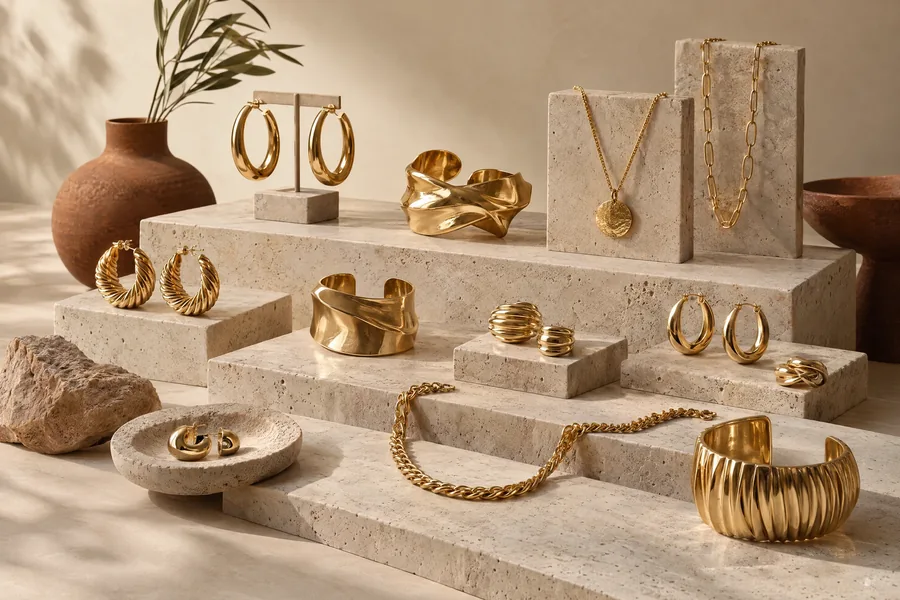
Styling language is strongest when it describes an observable relationship rather than a guaranteed result. “The curved outline can complement a rounded neckline” gives readers something to consider; “perfect for everyone” does not. Writers can strengthen jewelry product descriptions by explaining proportions, visual emphasis, or suggested combinations as subjective ideas. The sculptural design collection, for example, can be discussed as inspiration for balancing expressive shapes with simpler clothing, not as evidence of item construction.
Care instructions must follow the complete construction, including stones, coatings, settings, and any treatments. According to GIA’s jewelry care guidance, chemicals, heat, and sudden temperature changes can harm some jewelry materials, and ultrasonic cleaning is not universally safe. Avoid adding a standard ultrasonic recommendation to jewelry product descriptions. Pearls, organic materials, surface-filled stones, and other sensitive components require particular caution, while vibration can also loosen settings.
When construction is uncertain, advise consultation with a qualified jeweler instead of prescribing an aggressive home recipe. General guidance can include removing jewelry before swimming or household cleaning and keeping pieces separately padded to reduce scratching. Sterling silver benefits from anti-tarnish storage, while pearls and opals should not be kept excessively dry. Include such details in jewelry product descriptions only when relevant to verified materials, and distinguish general education from item-specific instructions that have actually been confirmed.
Use a Review Process That Keeps Claims Accurate
A repeatable review process protects accuracy without forcing every page into the same voice. Give jewelry product descriptions two separate checks: first for evidence, then for readability. During the evidence pass, compare every factual statement with the working record. During the readability pass, ask whether a customer can quickly find material identity, measurements, fastening, image status, and outstanding questions. This separation helps editors catch both unsupported claims and well-supported facts hidden inside decorative prose.
Watch especially for words that quietly introduce new claims. “Handmade,” “certified,” “ethically sourced,” and “hypoallergenic” are not harmless flourishes; they require appropriate substantiation, and jewelry should not be presented as guaranteeing freedom from allergy. Accurate jewelry product descriptions also avoid unsupported promises about healing or disease prevention. Price, value, warranty, availability, and service claims need their own evidence. A material document does not verify shipping arrangements, and an attractive image does not establish stock status.
Explore our product collection for individual designs, photographs, and product details. When considering jewelry product descriptions, look at each piece in the context of your own preferences and practical needs. Use the product description to check relevant specifications rather than relying on appearance alone. For a more personal recommendation or a question about a particular piece, contact katherine jewelry with the details that matter to you.
Assign responsibility for unresolved questions and record when information changes. A specification update should trigger a review of the title, description, measurement fields, image captions, and care notes together. For trade inquiries, jewelry product descriptions must not imply minimum orders, discounts, manufacturing capabilities, or lead times that have not been confirmed. Use the wholesale inquiry page to start a discussion and obtain actual terms through written quotation rather than embedding assumed arrangements in promotional copy.
Finish with a reader’s test: what would someone reasonably believe after seeing this page, and can every factual belief be supported? For questions about the inquiry website, the contact page offers a route to seek clarification, not a substitute for documented specifications. The best jewelry product descriptions make known facts easy to find, keep design interpretation visibly separate, and leave uncertainty honest. Precision is not the enemy of appealing writing; it gives that writing a dependable foundation.