Editorial guidance only. Product characteristics, care needs, and commercial terms should be confirmed in writing for any specific item.
A necklace can feel almost invisible with one shirt and surprisingly prominent with another. That difference often comes down to jewelry proportions: the relationships between an ornament, its surroundings, and the person wearing it. Size matters, but so do placement, open space, texture, and movement. This jewelry proportions guide for balanced personal styling treats those relationships as adjustable choices, not rules about which bodies should wear which designs.
In the design notes at katherine jewelry, jewelry proportions offer a useful way to explore visual balance. Start with the effect you want, then change one detail at a time until the arrangement feels intentional and comfortable.
Read Scale Through Shape, Contrast, and Open Space
Begin by separating physical size from visual presence. Two earrings with similar outer dimensions can create very different impressions: an open outline allows the background to show through, while a filled shape reads as a larger block. When considering jewelry proportions, look at how much visual space a piece occupies rather than judging only its stated measurements. A photograph against a plain background may not reveal how strongly it contrasts with your hair or clothing.
Contrast changes that impression again. A smooth, bright shape against a dark shirt may draw more attention than a larger, low-contrast shape against a patterned blouse. Texture and repeated details can also make a design feel busier. To assess jewelry proportions at home, view the whole outfit in a mirror from several steps away. Then move closer to see whether the details reward attention without becoming a competing focal point.
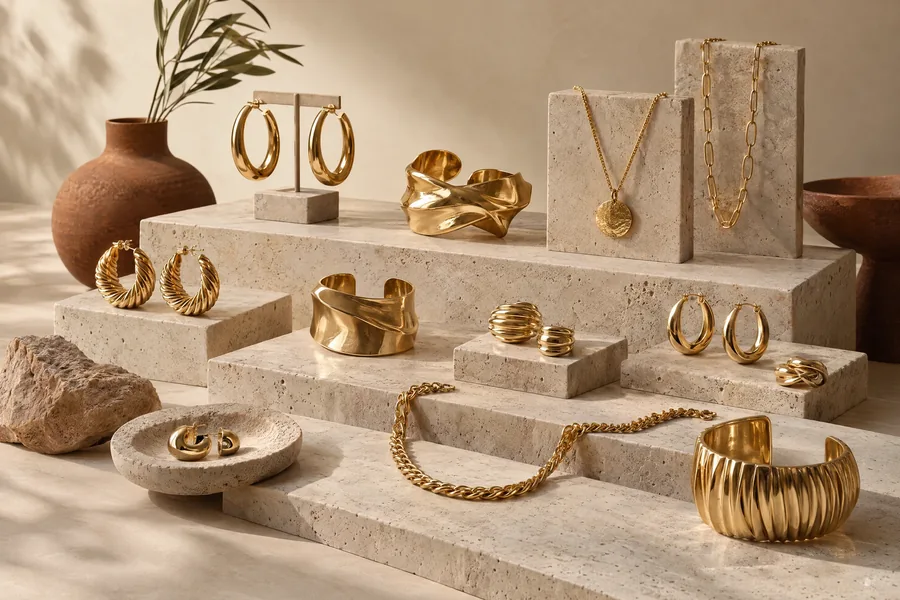
Choose a starting intention before choosing a size. Do you want a quiet accent, a visible frame around the face, or one unmistakable statement? For a plain crewneck and pulled-back hair, a rounded earring concept might become the main feature while a necklace remains optional. The earring design concepts can provide vocabulary for comparing outlines and silhouettes; they are inspiration rather than evidence of availability. Your jewelry proportions should support the intention you selected.
A useful test is to swap only one element while keeping the rest unchanged. Compare a narrow outline with a broader shape, or a short pendant with a longer one, using pieces you already own. Notice which arrangement you recognize first in the mirror. This isolates jewelry proportions from other influences such as a different hairstyle or jacket. Take photographs from the same distance if you want a consistent record, without treating the camera as a substitute for your own experience.
Do not turn the results into restrictions based on body size or face shape. A small piece can be deliberately dramatic through contrast, and a large piece can feel relaxed through openness. Balanced jewelry proportions need not mean everything is medium-sized or evenly matched. They mean that the relationships look chosen. If an unexpected combination expresses your style clearly, it has already passed a more useful test than any universal chart could provide.
Use Necklines and Hair to Set the Frame
Clothing supplies the frame in which jewelry is seen. A neckline creates a boundary; a collar adds edges; hair may conceal or reveal an earring. Before changing the jewelry, check those surroundings. With jewelry proportions, a pendant's landing point can matter more than its overall size. If it rests directly on a neckline seam, the two elements may look accidentally crowded. Moving it clearly above or below that boundary often makes the relationship easier to read.
For an open shirt, try a necklace that sits within the visible opening without tracing every edge of the collar. For a high neckline, compare a short piece above the fabric with a longer line over it. Neither approach is automatically better. These jewelry proportions create different effects: one concentrates attention near the face, while the other extends the composition down the torso. Check the arrangement seated as well as standing, because fabric and pendants can shift.
Hair introduces another variable, especially with earrings. A delicate outline may disappear into loose curls, while a broader silhouette remains visible; with hair tucked back, the same design may suddenly feel prominent. Exploring necklace styling concepts alongside earring shapes can help you imagine the complete frame. Evaluate jewelry proportions with the hairstyle you actually plan to wear, not only with your hair held aside during the first mirror check.
Imagine dressing for a dinner in a blouse with a wide, softly curved opening. You might begin with a necklace that echoes the curve, then discover that similarly rounded earrings make the area feel repetitive. Keep the necklace and try a more linear earring, or keep the earrings and remove the necklace. Adjusting jewelry proportions does not always require a smaller piece; changing direction or leaving one area empty can resolve the composition more effectively.
Use a simple boundary check before leaving: is each ornament clearly inside, outside, or intentionally crossing a clothing edge? Look for catches at the collar and visual collisions near buttons, scarves, or prominent embroidery. Thoughtful jewelry proportions account for those everyday details rather than a perfectly still pose. When the neckline already provides a strong decorative feature, an unadorned stretch of skin or fabric can act as breathing room, allowing both the garment and the jewelry to remain legible.
Build Layers and Hand Styling Around a Clear Priority
Layering works best when there is a reason for each addition. Start with one necklace you want to notice first, then introduce a second that changes the rhythm rather than merely duplicating it. In jewelry proportions, separation should be visible enough to read as deliberate. Two pendants landing at almost the same point may look tangled even when they are not. Try the combination on your actual neckline before deciding that the lengths work together.
Think about width as well as length. A broad chain and a substantial pendant can each claim attention, while a fine companion line may provide contrast. That is an editorial option, not a requirement to pair bold with delicate. More uniform jewelry proportions can also feel intentional if the repeated lines are the point. If a layered arrangement looks unclear, remove one piece first; only then decide whether a length or silhouette needs changing.
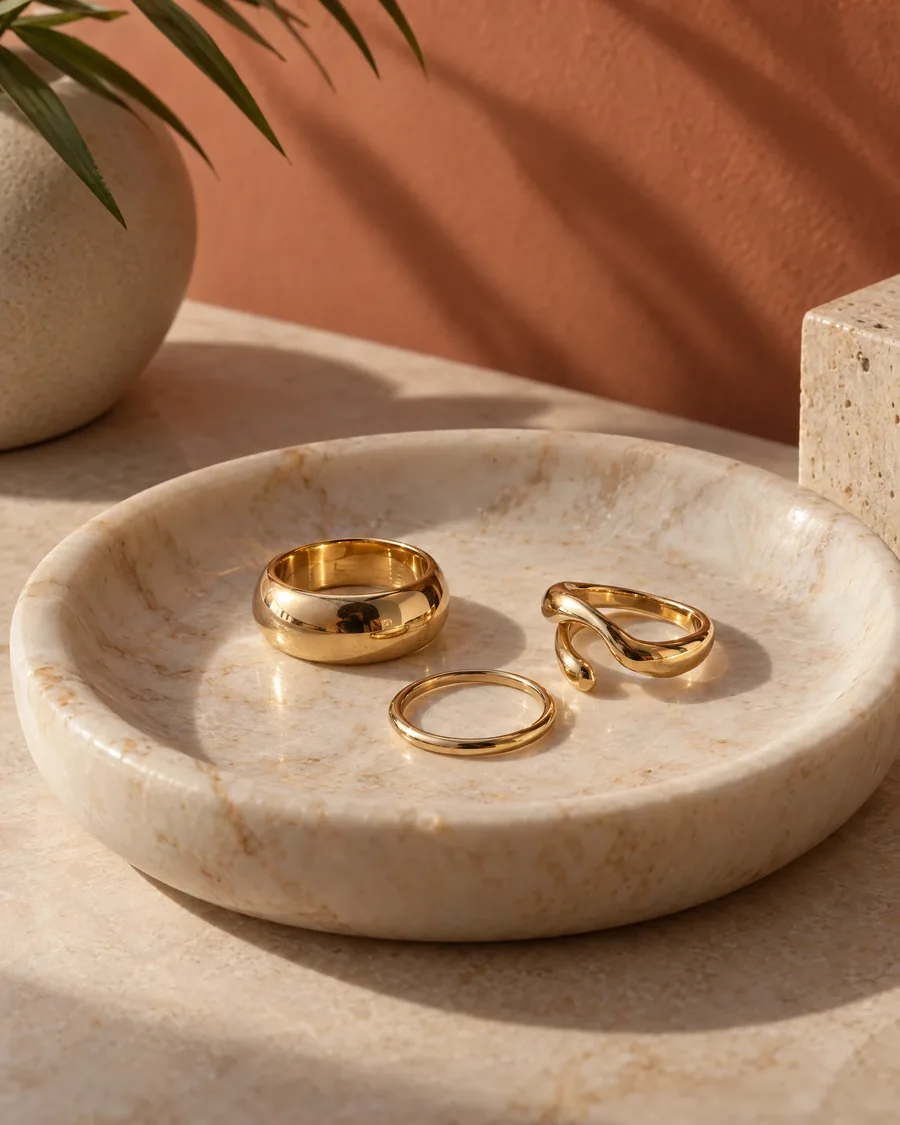
The hands offer a smaller, more mobile styling area. Rather than distributing rings evenly across every finger, choose where you want emphasis: one broad shape, a short stack, or a pair of contrasting forms. The ring design concepts offer starting points for comparing these arrangements. Judge jewelry proportions with your fingers relaxed and slightly spread, then close your hand gently. A composition that looks attractive but interferes with ordinary movement needs another approach.
Bracelets add a relationship with cuffs, watches, and rings. With a fitted sleeve, a single visible bracelet might create a cleaner outline than several pieces partly hidden beneath fabric. With a bare wrist, an uneven grouping may feel more lively. Consider jewelry proportions across the whole hand-and-wrist area instead of assessing each item separately. The bracelet styling concepts can help you compare narrow lines, repeated shapes, and broader silhouettes without assuming any particular material or stock status.
For a practical workday example, begin with the ring you enjoy most and one wrist accent. Type, hold a mug, and put on your jacket. If the arrangement feels crowded, remove the piece closest to the area of interference rather than shrinking everything at once. Successful jewelry proportions leave room for use as well as appearance. Recheck necklace layers after walking around, too: spacing that stays readable in motion is more useful than spacing that exists only in a posed photograph.
Edit the Whole Outfit for Movement and Personal Intent
The final check should consider the whole outfit rather than separate jewelry categories. If earrings, a pendant, rings, and a bracelet all demand equal attention, decide whether that abundance is intentional. There is nothing inherently wrong with it. But if you wanted a calmer result, jewelry proportions can help establish a priority. Keep the element that best expresses the mood, then simplify one neighboring area instead of automatically removing the largest object.
Movement may change your choice. Turn your head, bend an elbow, sit down, and reach for a bag. Earrings that brush a collar or bracelets that bunch against a cuff can change the visual arrangement and your comfort. Assess jewelry proportions during these ordinary actions, particularly when dressing for a long day. If a piece pulls, pinches, or repeatedly catches, treat that as a fit or construction concern rather than something you should tolerate for the composition.
Explore our product collection for individual designs, photographs, and product details. When considering jewelry proportions, look at each piece in the context of your own preferences and practical needs. Use the product description to check relevant specifications rather than relying on appearance alone. For a more personal recommendation or a question about a particular piece, contact katherine jewelry with the details that matter to you.
Make your own short styling record instead of searching for a permanent formula. Photograph three arrangements with the same outfit: one restrained, one focused on a single feature, and one more layered. Note where your eye goes first and what remains comfortable after movement. Over time, these comparisons turn jewelry proportions into a personal vocabulary. You may learn that you prefer open shapes near the face, concentrated detail on one hand, or a long line over uncomplicated clothing.
The most useful conclusion is not that every outfit needs perfect symmetry. It is that jewelry proportions become easier to manage when you identify the desired emphasis, check the surrounding boundaries, and leave enough space for movement. The styling perspective at katherine jewelry invites that kind of experimentation, without presenting one silhouette as correct for everyone. Begin with a piece you enjoy, make one purposeful adjustment, and stop when the whole arrangement feels clear enough to wear without further fuss.