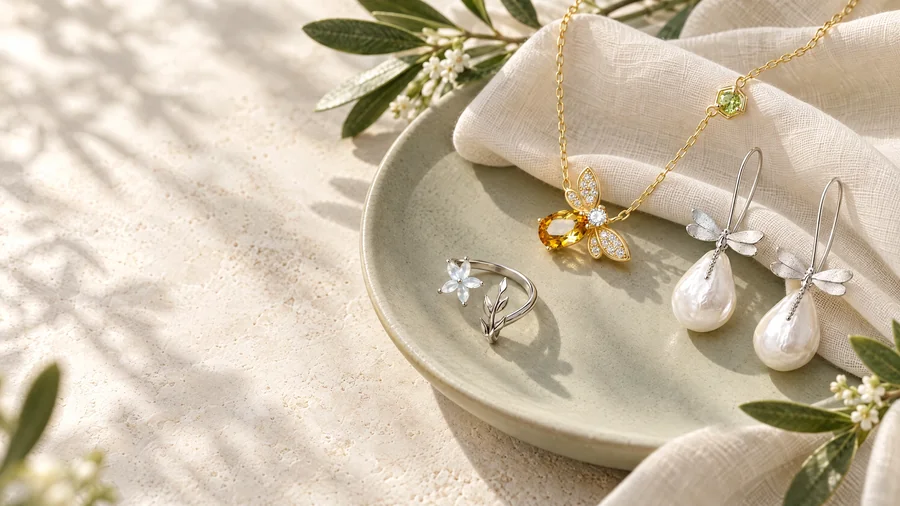
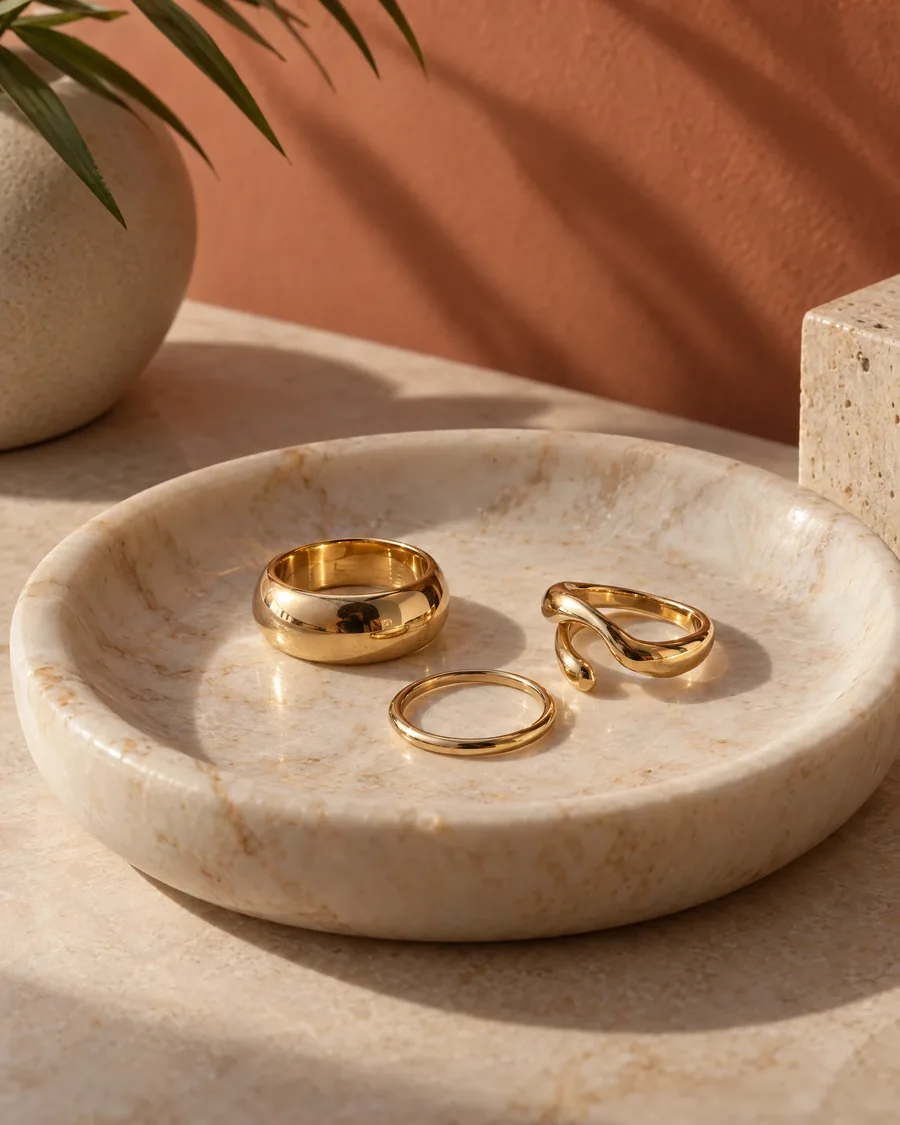
Editorial guidance only. Product characteristics, care needs, and commercial terms should be confirmed in writing for any specific item.
The difference between timeless jewelry and seasonal style is less about age than about usefulness. A restrained ring can feel wrong for your life, while an expressive piece can remain a favorite for years. The better question is whether a design keeps earning its place after its initial excitement fades.
When considering timeless jewelry versus seasonal trends for a personal collection, start with your clothes, routines, and preferences rather than a universal list of essentials. This guide explores how to recognize lasting appeal, experiment without overcommitting, assess practical longevity, and build a collection that leaves room for both consistency and change.
Judge Lasting Style Against Your Actual Wardrobe
A useful definition of timeless jewelry is a design you can imagine choosing repeatedly, even when the surrounding fashion changes. That does not require minimalism. A broad cuff, richly colored pendant, or sculptural ring can have lasting appeal if it reflects your established taste. Start by naming three qualities you regularly enjoy: perhaps curved shapes, strong contrast, or delicate proportions. These are more informative than a generic checklist of classics.
Test those qualities against clothes you actually wear. Choose an ordinary work outfit, a relaxed weekend combination, and something for a social occasion. Imagine the same piece with each, noting whether its scale, length, and visual weight make sense. For your purposes, timeless jewelry should work in several relevant settings, not every conceivable one. A necklace that suits your usual necklines may be more useful than a supposedly universal style you never reach for.
Explore our product collection for individual designs, photographs, and product details. When considering timeless jewelry, look at each piece in the context of your own preferences and practical needs. Use the product description to check relevant specifications rather than relying on appearance alone. For a more personal recommendation or a question about a particular piece, contact katherine jewelry with the details that matter to you.
Another test is to remove the trend label. Would you still like the design if nobody described it as current, vintage-inspired, or essential? If the answer depends entirely on its popularity, treat it as an experiment rather than an anchor. Your version of timeless jewelry can still be distinctive. What matters is whether the attraction comes from your own preferences or mainly from the reassurance of seeing a style repeatedly.
Finally, look backward before deciding what belongs next. Which existing pieces have survived changes in your clothing, job, or social routine? Note their shared features, including comfortable dimensions and familiar shapes. Those patterns give you a personal brief for timeless jewelry. They can also reveal exceptions: perhaps your most frequently worn item is bold, while several quiet pieces remain untouched. Let that evidence outweigh rules suggesting that lasting style must always be discreet.
Use Seasonal Accents as Controlled Experiments
Seasonal styling can refresh a collection without replacing its foundations. Treat timeless jewelry as the familiar base and a new proportion, texture, or color as the variable. For example, keep your usual pendant and change the earrings, or retain a comfortable ring arrangement while trying a more expressive bracelet. Changing one element at a time makes it easier to identify what you genuinely enjoy rather than reacting to an entirely unfamiliar look.
Before acquiring anything, try the visual idea with what you own. Move a pendant to another suitable chain if the components are compatible, wear one existing ring on its own, or pair familiar earrings with a different neckline. Sometimes the desire for novelty is really a desire for a new composition. Timeless jewelry becomes more versatile when you change its surroundings, and that can satisfy the urge for freshness without adding another object.
When a design is genuinely new to you, write a short use case. Instead of saying, “I want larger earrings,” specify, “I want earrings that bring definition to simple evening clothes without competing with a high collar.” Browse earring style concepts for differences in shape and emphasis. A clear purpose makes comparing timeless jewelry with seasonal accents less abstract: each piece should have a job, whether frequent wear or occasional expression.
Give an unfamiliar style time to settle before declaring it your new signature. Revisit the idea on different days and with several outfits; save a reference image and notice whether its appeal persists after the first viewing. This is not a test of whether others approve. It is a way to separate lasting interest from momentary excitement. Timeless jewelry often emerges from repeated preference, while seasonal choices can remain enjoyable without needing to become permanent favorites.
Set a boundary for experiments that fits your space and spending priorities, rather than following a prescribed ratio. You might allow one expressive addition at a time, or require a specific wardrobe gap before considering another. There is no need to justify every playful piece as timeless jewelry. An occasional accent can earn its place through pleasure and usefulness, provided you understand its limited role and do not mistake novelty for a collection-wide necessity.
Separate Enduring Design From Physical Longevity
A shape can remain appealing while its construction proves unsuitable for frequent wear. Evaluating timeless jewelry therefore requires two separate questions: will you keep liking it, and can you maintain it appropriately? A delicate setting may suit occasional use but conflict with hands-on work. A projecting ring detail may catch on knitwear. These are not judgments about beauty; they are practical mismatches that can prevent an otherwise appealing design from becoming a dependable favorite.
Material appearance alone cannot answer the second question. A silver-colored surface does not establish sterling silver, and a gold-colored finish does not identify the metal beneath it. Plating is a surface layer, not the same construction as solid metal throughout. When assessing timeless jewelry, request written details about metal content, gemstone identity, treatments, and coatings. The FTC Jewelry Guides explain why accurate descriptions matter; an attractive photograph is not a substitute for them.
Next, consider the full piece rather than one material in isolation. Stone settings, joins, clasps, and surface finishes all affect how an item behaves in use. For a ring, check fit, movement, and interference with neighboring fingers; professional fitting and the seller's sizing guidance should take priority over approximate online methods. A candidate for timeless jewelry should suit your ordinary activities. If you must constantly adjust it or worry about catching it, its theoretical versatility offers little benefit.
Care requirements also belong in the decision. GIA advises removing jewelry before swimming or household cleaning, keeping pieces separately padded, and recognizing that heat, chemicals, and sudden temperature changes can harm some materials. Consult GIA's jewelry care guidance before selecting a cleaning method. Timeless jewelry is not maintenance-free, and ultrasonic cleaning is not universally safe: treatments, sensitive materials, and settings can make it inappropriate. A qualified jeweler should assess uncertain construction.
Match those needs to habits you can realistically sustain. Someone who wants a simple routine should avoid assuming that every visually simple piece has simple care requirements. Before treating an item as timeless jewelry, ask how it should be stored, cleaned, and checked, and whether any finish needs particular attention. Use the contact page for inquiries about website information; actual material details and terms require written confirmation rather than assumptions based on editorial images.
Build a Collection With Clear Roles and Room to Change
Begin with a small inventory organized by use, not by prestige or trend status. Separate frequent-wear pieces, occasion-specific pieces, and items you rarely choose. For each, record why it works or does not: comfortable fit, suitable length, awkward clasp, or a color that clashes with your wardrobe. This makes timeless jewelry a practical category grounded in experience. It also prevents a familiar mistake: buying another version of something you admire but repeatedly leave unworn.
Assign roles before filling gaps. You might need one unobtrusive piece for busy days, one focal point for plain clothing, and one option that suits dressier occasions. A single item may cover two roles, which is useful when storage or spending is limited. Look through necklace design inspiration to compare placement and visual emphasis. Choose timeless jewelry according to the role it can actually fulfill, not because a list says every collection must contain it.
Try a simple outfit exercise using a hypothetical collection. A familiar band and small earrings create a quiet base for a patterned shirt; the same band with a prominent pendant gives a plain top more definition. For an evening look, you might omit the pendant and emphasize earrings instead. Here, timeless jewelry supplies continuity while the styling changes. The point is not to wear everything together, but to let each combination have a clear focal point.
Review the collection when your routine changes, rather than automatically with each season. A different job, more travel, or new clothing preferences may alter what feels useful. Move rarely worn pieces into an occasional-use group before deciding they have failed. Some designs remain meaningful without being everyday choices. Personal timeless jewelry can include sentimental or expressive pieces whose value lies in a particular occasion, provided you distinguish that role from the demands of regular wear.
The lasting-versus-seasonal decision is ultimately about balance, not purity. Keep designs that support your life, experiment where curiosity is genuine, and insist on clear information when evaluating physical longevity. The design concepts at katherine jewelry can help you articulate a preference, but your own wearing experience should guide the final judgment. Build around timeless jewelry that feels recognizably yours, then let seasonal accents contribute variety without requiring you to reinvent the collection whenever your attention shifts.