Editorial guidance only. Product characteristics, care needs, and commercial terms should be confirmed in writing for any specific item.
A successful jewelry display makes a collection easier to understand, not simply more decorative. Visitors should be able to notice a focal piece, recognize related designs and find the information they need without searching through crowded stands. For a small boutique presentation, clarity matters more than the number of objects on show.
Explore our product collection for individual designs, photographs, and product details. When considering jewelry display, look at each piece in the context of your own preferences and practical needs. Use the product description to check relevant specifications rather than relying on appearance alone. For a more personal recommendation or a question about a particular piece, contact katherine jewelry with the details that matter to you.
Build a Visual Hierarchy Before Choosing Fixtures
Start with the story a visitor should understand in a few seconds. A jewelry display might introduce sculptural silhouettes, show several necklace lengths or explain how a coordinated grouping works. Choose one primary message for each viewing area. When every object receives the same visual emphasis, people must work harder to decide where to look. A clear hierarchy gives the collection an entry point without hiding its supporting designs.
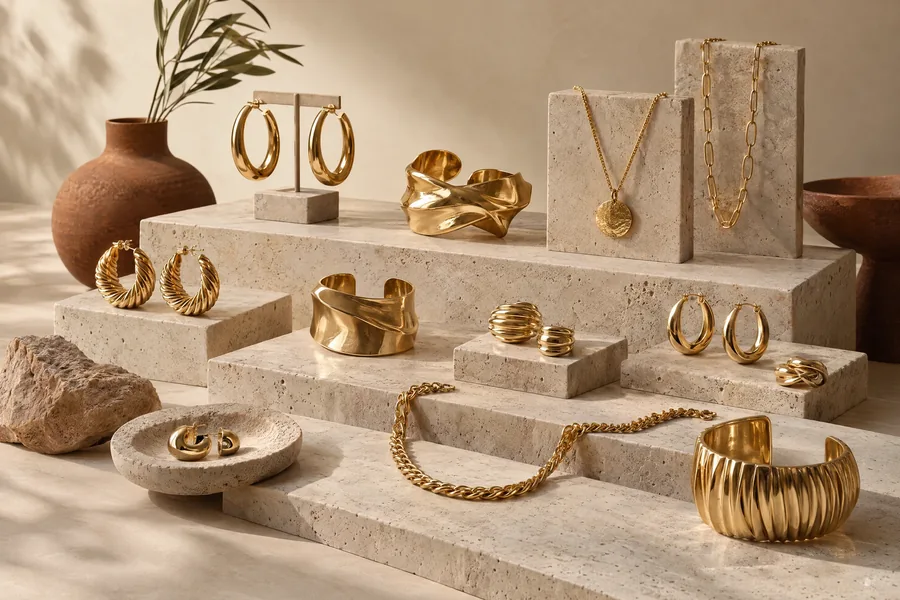
For a narrow counter, sketch the available footprint before buying stands. Mark a focal position, a supporting group and a clear area where a piece can be examined. Build your jewelry display around that working space rather than filling it last. A taller support can establish the focal position, but height should not obscure smaller pieces behind it. Check the arrangement from the visitor’s side, not only from behind the counter.
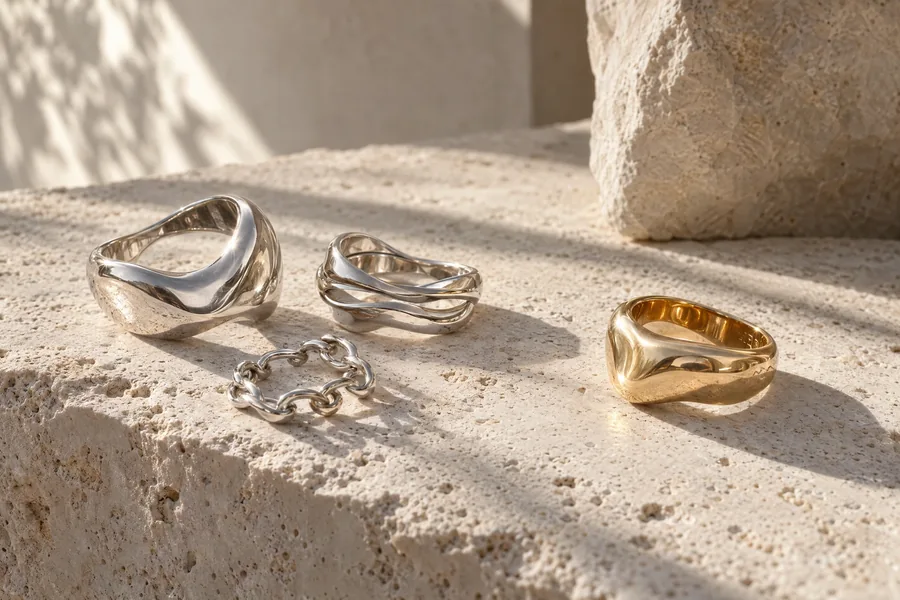
Group by one understandable relationship at a time: shape, scale, intended styling or category. For example, a jewelry display exploring curved forms could place a bold necklace beside smaller earrings with a related outline. Avoid assuming that similarly colored pieces share a metal or gemstone identity. For visual planning, the sculptural collection concepts and earring design concepts can help you think about relationships between shapes without implying stock availability.
Give each group enough breathing room that its boundaries are visible. A useful test is to ask someone unfamiliar with the arrangement which pieces belong together. If they cannot tell, remove a prop or widen the gap before adding explanatory text. In a compact jewelry display, one neutral support system often works better than several unrelated fixture styles. Texture can add interest, but prominent patterns may compete with delicate outlines and small details.
Finally, distinguish visible selection from storage. You do not need to show every variation at once to communicate breadth. Keep secondary options in an organized, separately padded tray for assisted viewing, where appropriate. Photograph the proposed jewelry display and inspect the image at a small size: the focal point should remain obvious. If the photograph reads as a dense patch of shine, simplify the arrangement before changing the lighting or buying more furniture.
Use Lighting and Backgrounds to Improve Legibility
Lighting should help visitors see proportion, surface detail and color, rather than produce sparkle at any cost. Begin by checking the ambient light, then add focused illumination only where it improves visibility. A jewelry display can look attractive from one angle yet disappear into glare from another. Walk through the likely approach route and inspect it at seated and standing heights, especially if glass separates the viewer from the pieces.
Test backgrounds with actual samples whenever their materials are known. A pale surface can clarify a dark outline; a darker surface may make a light silhouette easier to distinguish. Neither choice is universally better. For a jewelry display containing fine chains, a smooth matte backing may reveal their path more clearly than a textured fabric. Avoid treating background color as proof of quality: it is a presentation choice, not evidence about construction or value.
Control reflections before increasing brightness. Move a lamp slightly to the side, change its angle or reposition a glossy support so that reflected light does not land directly in the viewer’s eyes. When evaluating a jewelry display, look specifically for washed-out details and shadows beneath raised settings. One additional light may solve a shadow, but several competing spotlights can create visual confusion. Compare adjustments individually so you know which change actually helps the presentation.
Color also needs honest treatment. Gem color appearance can differ under lighting and on screens, so avoid promising that a photograph captures an exact shade. For conceptual arrangements, the necklace design collection can suggest ways to organize different lengths, but editorial images cannot validate material identity. In a real jewelry display, let visitors compare pieces under consistent lighting and explain significant differences between the viewing conditions and any accompanying photographs.
Consider care alongside appearance. According to GIA’s jewelry care guidance, light, heat and sudden temperature changes can damage some gemstones and organic materials. Do not place an unverified piece beneath a hot lamp or in prolonged direct sunlight simply because it photographs well. Review the jewelry display for warm spots and exposure patterns throughout the day. Where construction or materials are uncertain, ask a qualified jeweler about suitable conditions rather than assuming every item tolerates the same setup.
Make Labels Useful, Accurate and Easy to Compare
A label should answer the next sensible question, not compete with the object. Establish a consistent sequence for information: design name or identifier, verified material details, relevant dimensions and any confirmed commercial information. For a conceptual jewelry display, clearly identify examples as design inspiration instead. If a detail is unknown, leave it unclaimed or explain that confirmation is needed. Appearance alone cannot establish metal content, gemstone identity or how a piece was produced.
The FTC Jewelry Guides emphasize truthful representations of jewelry characteristics, including materials, treatments, origin, price and value. Apply that principle to every label and spoken explanation accompanying a jewelry display. Terms such as plated, solid, lab-created and imitation should not be substituted for one another. Request written material information from the relevant supplier before preparing factual cards, and keep that documentation accessible to whoever will answer visitor questions.
Separate styling interpretation from product description. “A strong focal shape for a simple neckline” is an editorial suggestion; a statement about metal content requires verification. A jewelry display can communicate both, but they should occupy clearly different roles. Put the factual identifier on the main card and a short styling observation on a shared group card. This reduces repetition while letting visitors distinguish what the piece is from how someone might choose to wear it.
Legibility matters more than elaborate typography. Test the card at the distance from which visitors will actually read it, using lighting similar to the final setup. If someone must lean over the case to decipher essential information, enlarge the type or shorten the wording. In a small jewelry display, align labels consistently with their pieces and use identifiers to prevent ambiguity. A beautiful card is not useful if viewers cannot tell which object it describes.
For an inquiry-led presentation, make the next step explicit without suggesting an immediate purchase process. The design overview provides a place to explore concepts, while the contact page supports questions to katherine jewelry. Do not imply that displayed illustrations confirm availability, specifications or ordering terms. If a jewelry display supports a potential business collaboration, collect the visitor’s requirements and seek written confirmation of actual terms rather than improvising prices, minimum quantities or timelines.
Plan Handling, Security and a Repeatable Reset
A presentation is not finished until someone can use it comfortably. Decide where a visitor will stand, where a team member will place a viewing tray and how a piece returns to its assigned position. A jewelry display should support that sequence without requiring people to reach across unrelated objects. Keep a clear handover zone and avoid placing tall fixtures where they block sightlines between the people discussing a piece.
For a shared appointment table or temporary boutique event, establish a simple handling routine. Present a manageable selection, keep its identifiers together and return it before introducing another group. Adapt supervision and secure storage to the setting and the value of the actual objects. The jewelry display itself is not a security system. Check that supports are stable, trays sit fully on the surface and cables cannot catch sleeves or pull equipment from the counter.
Careful handling also protects the collection’s appearance. Keep pieces separately padded when they are not being viewed, and avoid placing them directly against hard or abrasive props. Cleaning methods must suit the complete construction; unknown materials should not receive aggressive home treatments or automatic ultrasonic cleaning. Build the jewelry display routine around condition checks rather than constant polishing. Note loose components or visible changes and refer concerns to a qualified jeweler before continuing assisted viewing.
Create a reset reference that someone else can follow. Photograph the approved arrangement, assign each position an identifier and record which label belongs with which piece. After an appointment, compare the jewelry display with that reference and check that the handover zone remains empty. For a temporary presentation, include packing positions in the same record. Separate cushioned compartments make it easier to preserve the arrangement’s organization while reducing contact between pieces during transport.
Evaluate the setup through ordinary questions, not invented performance promises. Can a new visitor identify the focal group? Can they read the labels without help? Can a piece be presented and returned without disrupting its neighbors? The best jewelry display ideas for a small boutique presentation resolve these practical issues before adding decoration. A clear jewelry display earns its place by making observation, conversation and careful handling easier; adjust it whenever those tasks become harder than they need to be.