Editorial guidance only. Product characteristics, care needs, and commercial terms should be confirmed in writing for any specific item.
Some pendant necklaces feel like punctuation: a small, deliberate detail that makes an outfit unmistakably yours. Others become the starting point for everything you wear around them. Neither approach is better. What matters is finding a shape, scale and way of wearing it that suits your taste without demanding a different wardrobe or an elaborate styling routine.
Learning how to choose pendant necklaces for personal style begins with observation rather than a shopping checklist. Notice the clothes you repeat, the details you enjoy and the accessories you leave untouched. Then use those clues to choose a signature you can actually imagine wearing on an ordinary day.
Define your signature through shape and meaning
Before comparing pendant necklaces, give the piece a job. Do you want a discreet finishing touch, a reminder of something personal, or a focal point for simple clothes? Choose one priority first. A design can serve several purposes, but knowing its main role helps you distinguish an appealing image from something that genuinely belongs in your wardrobe. Write your intention in a few words, such as quiet and graphic or playful with a personal connection.
Next, separate symbolism from appearance. An initial, botanical outline or familiar motif might carry an obvious association; an abstract curve can be meaningful without representing anything specific. You do not need a story that other people understand. Equally, liking a shape is reason enough to wear it. If a symbol has cultural or religious significance, learn what it represents before choosing it merely for its outline, especially when it belongs to a tradition unfamiliar to you.
Look at five outfits you wore recently, not five outfits you hope to wear someday. Note recurring features: crisp collars, soft knits, plain colors, lively prints or relaxed layers. For pendant necklaces, this gives a useful design brief. A clean outline may echo a streamlined wardrobe, while an irregular shape can introduce contrast. If most of your clothing is patterned, consider whether you want a pendant that remains visible or one that quietly blends into the composition.
Explore our product collection for individual designs, photographs, and product details. When considering pendant necklaces, look at each piece in the context of your own preferences and practical needs. Use the product description to check relevant specifications rather than relying on appearance alone. For a more personal recommendation or a question about a particular piece, contact katherine jewelry with the details that matter to you.
A useful final filter is the explanation test: would you still enjoy the design if nobody asked about it? Pendant necklaces chosen mainly to impress an imagined audience can feel less satisfying in everyday use. Keep the option that appeals both at first glance and alongside your ordinary clothes. When two pendant necklaces feel equally promising, favor the one whose shape you can describe clearly; that often reveals which visual idea matters most to you.
Find the right scale and landing point
The most useful way to assess pendant necklaces is against your body and clothing, not against a blank product background. Scale involves width, thickness and visual density as well as height. An open shape may look lighter than a solid-looking form of similar dimensions. Instead of deciding that you always suit small or large jewelry, ask how much attention you want the necklace to receive in a particular outfit. Different days can call for different answers.
Make a paper silhouette using the stated pendant dimensions, then hold it at different points along your neckline. This cannot reproduce weight, shine or construction, but it can expose a size mismatch before you commit. Use an existing chain or a measuring tape to estimate placement, remembering that a chain follows a curve rather than a straight vertical line. Include the pendant's drop below the chain when judging where its lowest edge will land.
Necklines provide boundaries, not rules. With a crew neck, try placing the pendant clearly above the fabric edge or clearly below it; hovering directly on the edge may look unresolved. With a V-neck, compare a placement inside the opening with one that extends beneath it. Over a high-necked knit, pendant necklaces can create a visible center line, although fabric texture may compete with fine details. Test each option with the actual top rather than relying on neckline diagrams alone.
Movement changes the picture. Sit down, reach forward and put on your usual jacket while checking the proposed placement. Notice whether the pendant meets a button, slips into an opening or presses awkwardly against a desk when you lean forward. A paper test only checks position; assessing real pendant necklaces also requires checking the chain, bail and balance. When possible, view the piece from the side as well as the front, because thickness can affect how it rests.
Finally, step back from the mirror far enough to see the complete outfit. If the pendant disappears, decide whether that subtlety is intentional before choosing more scale. If it dominates, remove another competing detail before rejecting it. Compare earring styling concepts to think through neighboring accessories. Pendant necklaces need not match earrings exactly: repeating a curve or keeping a similar visual weight can connect the pieces without making everything identical.
Layer with hierarchy rather than accumulation
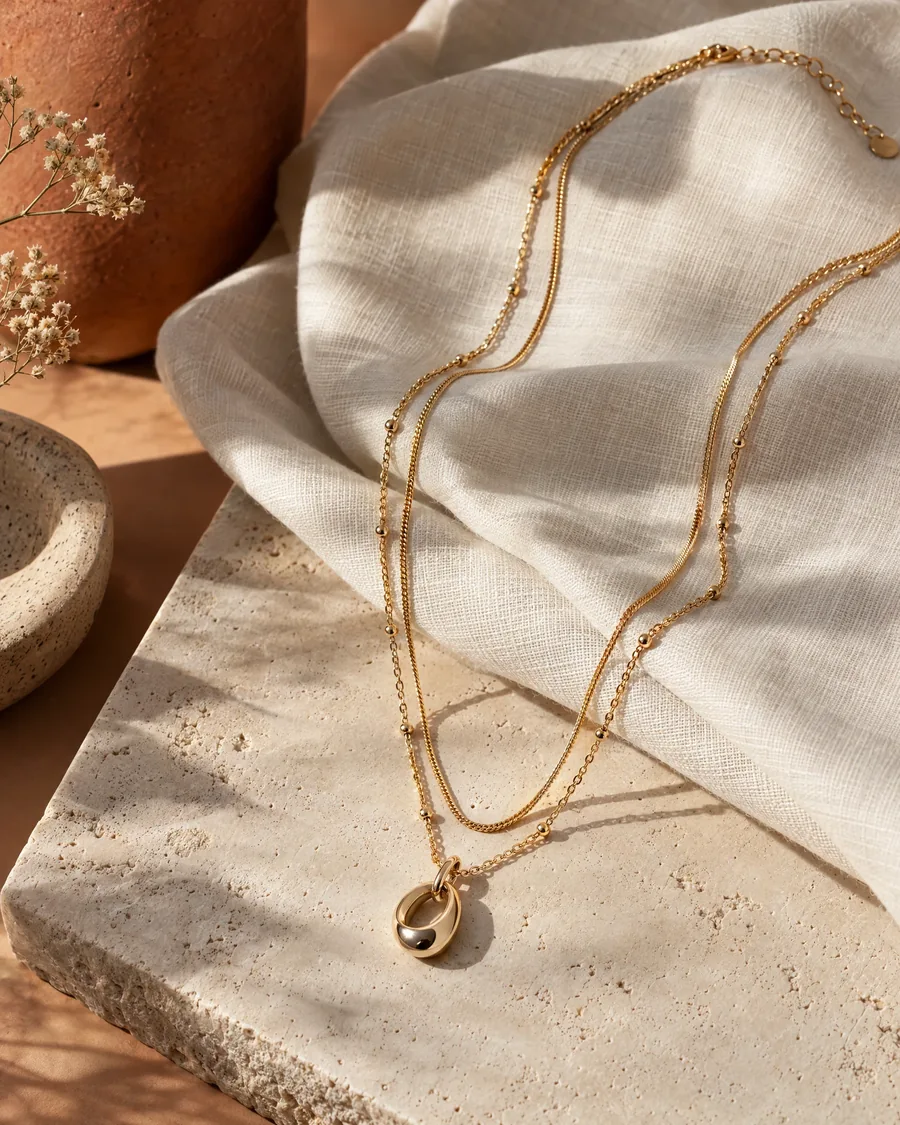
Layering pendant necklaces works best when you can identify the main piece immediately. Start with that pendant alone, wearing the neckline you intend to use. Add one plain chain or a second, quieter pendant only after deciding what the addition contributes. It might frame the focal point, introduce a different texture or fill an otherwise empty area. If you cannot name its role, the extra layer may be adding complexity rather than expression.
Spacing should allow each element to remain readable. Two pendants that settle at almost the same point can overlap, hiding the shapes you chose them for. Try a visibly shorter supporting chain, then check whether the gap survives movement. Chain length alone does not determine the result: pendant size, attachment and the way each chain drapes also matter. Treat the first arrangement as a trial, and change one element at a time so you can see what improves it.
For an uncomplicated combination, vary one feature while keeping another consistent. Pair a rounded pendant with a plain chain of similar visual tone, or combine two simple outlines at different scales. Pendant necklaces with several strong motifs can compete when every piece asks for equal attention. Deliberate contrast is still an option: a soft curve against a crisp shirt can be striking. The distinction is whether you have created a focal point or several unresolved ones.
Photograph the arrangement from a normal conversational distance, not only close up. Check whether the pendant remains identifiable and whether a chain crosses a printed detail or collar edge awkwardly. Walk around for a few minutes, then inspect again for twisting, contact between pieces or snagging. Layered pendant necklaces that look balanced while standing still may behave differently during a commute. If a combination needs constant correction, simplify it or reserve it for occasions when that adjustment feels worthwhile.
You can also create a layered impression across the outfit without adding another necklace. A bracelet can repeat an angular form; earrings can echo a rounded outline. Explore bracelet design inspiration for this kind of visual connection. Leave some features different so the result feels considered rather than uniform. On days with a patterned scarf or detailed collar, wearing pendant necklaces individually may give your chosen signature more clarity than even a carefully planned stack.
Choose for daily life and keep the signature flexible
Before settling on pendant necklaces, imagine a normal weekday from dressing to getting home. Do you wear a scarf, carry a crossbody bag or change for exercise? A projecting edge may catch on loose fabric; a long pendant may move around when you bend. Think about how easily you can use the clasp and whether the weight feels comfortable over time. These practical details deserve as much attention as the first mirror impression.
Appearance cannot establish what a piece is made of. When evaluating pendant necklaces, request written details about the chain, pendant, coatings and any stones, including relevant treatments. A metallic color does not establish metal content, and plating is not the same as solid metal throughout. The FTC Jewelry Guides explain why accurate material descriptions matter. General styling education is not a material report about the concepts pictured on this website.
Care should follow confirmed construction rather than a universal cleaning recipe. The GIA jewelry care guidance explains that chemicals, heat and sudden temperature changes can harm some materials, and ultrasonic cleaning is not suitable for every piece. Remove jewelry before swimming or household cleaning, and store items separately with padding to limit scratches. For pendant necklaces with uncertain components or treatments, ask a qualified jeweler about suitable cleaning rather than experimenting with aggressive household methods.
Keep a small styling record once you find a combination you enjoy. A photograph with a favorite shirt and a note about placement can save time when dressing again. If an option remains unworn, identify the obstacle before replacing it: perhaps the length is awkward, the motif feels too formal or it competes with your preferred earrings. For questions about the website's design concepts, use the katherine jewelry contact page without treating an illustration as an offer of a specific item.
Ultimately, choosing pendant necklaces is an exercise in useful editing. Select a design you enjoy, place it deliberately, give it room among other accessories and check that it suits your routine. Your signature need not be one piece worn forever; it can be a recurring preference for a shape, proportion or mood. The strongest choice is not the one that satisfies every possible outfit, but the one that makes familiar clothes feel more distinctly your own.