Editorial guidance only. Product characteristics, care needs, and commercial terms should be confirmed in writing for any specific item.
Layered necklaces can turn a familiar outfit into something more personal, but overlapping pendants and twisted chains can make the effect feel accidental. A successful combination starts with space: between lengths, between focal points and between the jewelry and your clothing. Learning how to style layered necklaces without tangling means considering movement as carefully as appearance. There is no arrangement that guarantees a knot-free day, yet a few thoughtful adjustments can reduce crossing and make your stack easier to wear. Start with two pieces, test them with your actual outfit, and add another only when each existing layer has a clear role.
Find the right spacing for your neckline
Begin with your clothes rather than the jewelry tray. The neckline sets the available space for layered necklaces: an open shirt offers a different frame from a high crew neck or a deep V. Decide whether the pieces will sit mainly against skin, mainly over fabric or across both. A pendant resting directly on a garment edge can disappear behind it or catch as you move, so shift that layer clearly above or below the boundary.
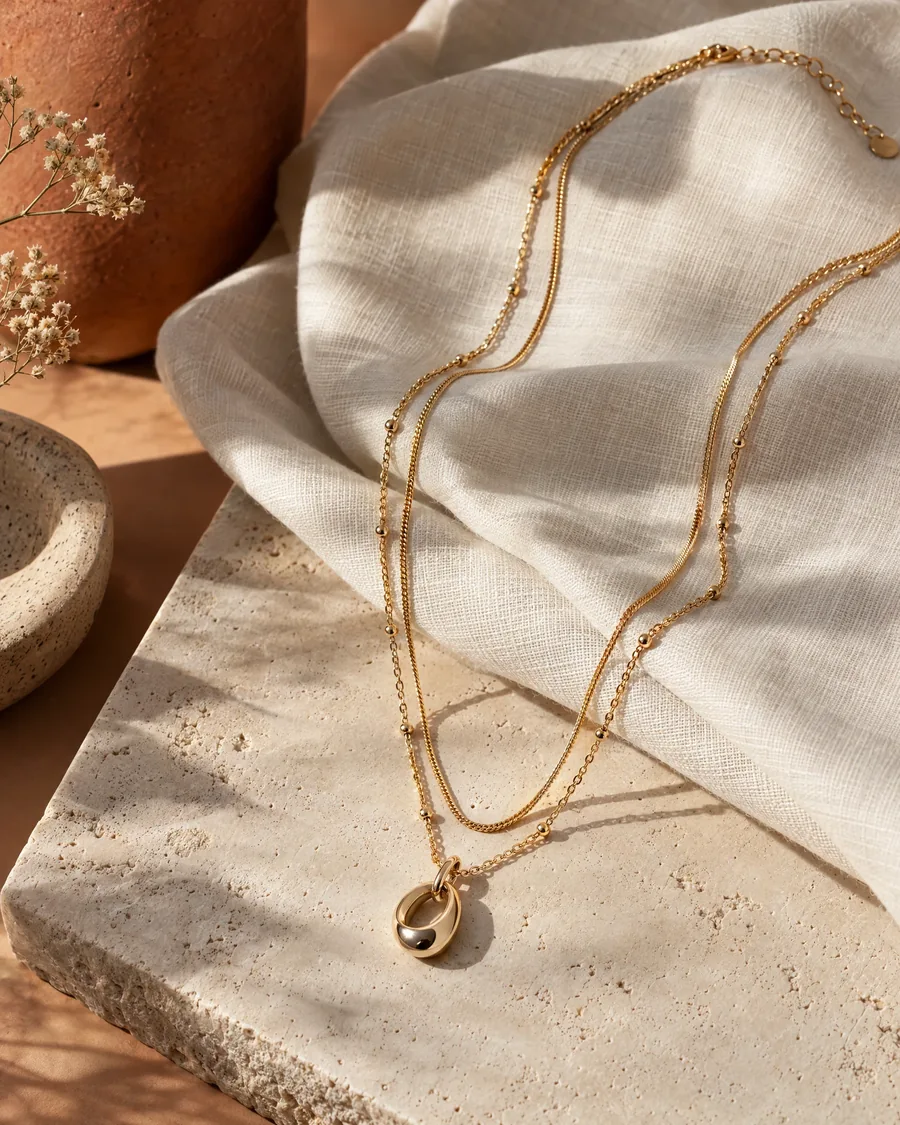
Choose an anchor necklace whose position you already like, then add a second piece that lands noticeably lower. For layered necklaces, roughly two finger-widths of visible separation can be a useful starting point, not a universal sizing rule. Measure the gap between the lowest points of the pieces, including pendants, rather than comparing chain lengths alone. A long pendant on a shorter chain can occupy the same space as a longer plain chain.
With a crew-neck tee, try one short necklace above the fabric and a longer pendant against the shirt. With an open collar, keep the shortest piece inside the opening and check that the second does not vanish beneath a folded edge. Layered necklaces also need room sideways: a broad pendant can overlap neighboring chains even when its tip sits lower. If the opening is narrow, two quiet layers may work better than three crowded ones.
Adjustable fastenings offer a way to experiment before changing the whole combination. Move one necklace a fastening point at a time and observe the result with relaxed shoulders. Do not assume that identical stated lengths sit identically on the body; chain structure and pendant shape affect their position. The necklace design concepts at katherine jewelry can help you compare silhouettes as inspiration, rather than as evidence of available merchandise.
Finish this stage with a seated check. When you sit, the neckline may rise and the lower necklace may collect fabric beneath it. If layered necklaces look distinct standing up but merge at a desk, widen the gap or remove a piece. Photograph the successful arrangement with that particular top. A small record of lengths and fastening positions makes it easier to recreate layered necklaces without rebuilding the stack from scratch.
Give each layer a different visual job
Once the spacing works, decide what should catch the eye first. Layered necklaces usually feel more composed when one piece leads and the others support it. That lead might be a pendant, a pronounced chain silhouette or a strand with repeated rounded forms. Choose it deliberately, then ask whether every additional necklace contributes a new line or simply competes with the same detail. A quieter companion often makes the focal piece more noticeable.
Think in terms of visual weight, not just physical size. A reflective surface can attract attention even when the necklace is fine; a broad matte-looking shape may read more softly. For layered necklaces with a bold pendant, try a simple upper chain and leave clear space around the pendant's outline. If both pieces have decorative drops, stagger their positions enough that you can recognize each shape from several feet away, not only close to the mirror.
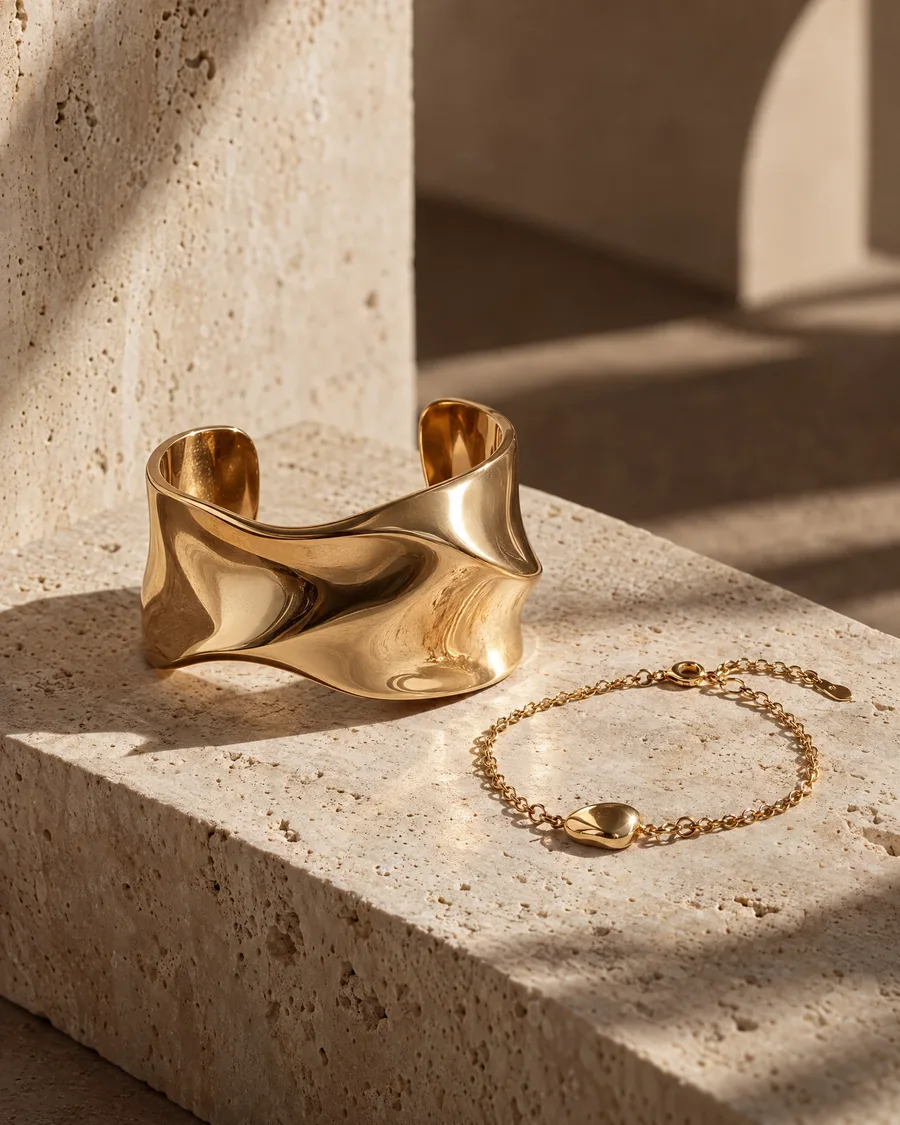
Texture provides another way to separate the layers. A smooth-looking chain beside a more articulated link pattern can create contrast without adding another pendant. However, attractive contrast does not automatically mean the pieces will move well together; that requires a separate test. Browse sculptural jewelry inspiration for ideas about shape and negative space. Consider how an open outline or a compact form changes the composition rather than treating every dramatic shape as something to combine.
Matching metal colors is an option, not a requirement. Mixed-tone layered necklaces can feel connected when you repeat another feature, such as rounded shapes or similar proportions. Against a patterned blouse, fewer contrasting details may be easier to read; against a plain shirt, you have more room to experiment. These are editorial choices, not rules or measured trends. Look at the whole outfit, including the colors already present in buttons, glasses and bag hardware.
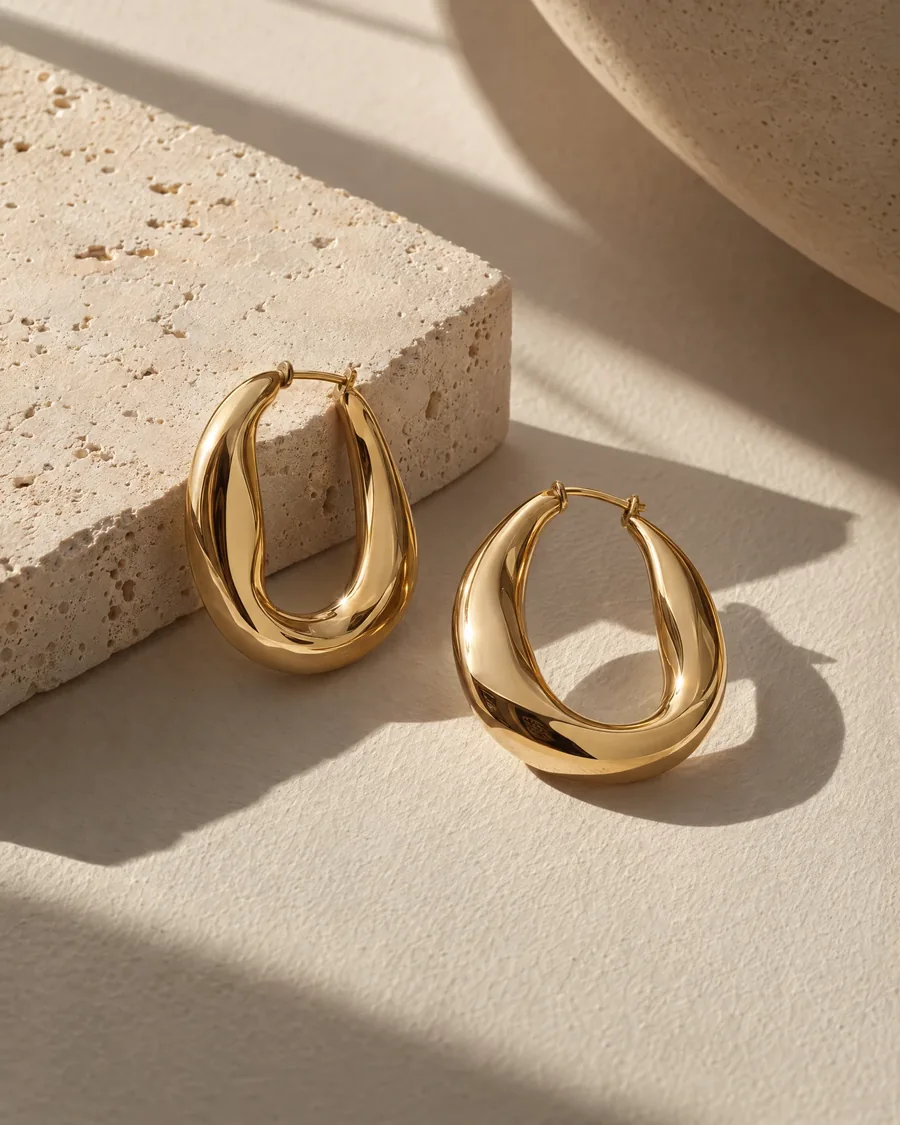
Use your earrings as a final balancing tool. If they are large and expressive, simplify the stack; if they are understated, the neckline can carry more detail. Compare the earring design concepts for scale rather than seeking an exact matching set. Take a photograph at conversational distance and identify the first thing you notice. If layered necklaces register as one crowded patch, remove the most repetitive piece before adding anything else.
Test movement and tackle the source of tangles
Layered necklaces move independently, so some crossing is normal. The useful question is whether a pairing repeatedly winds together or catches at the same point. Start with two necklaces and identify their behavior before introducing a third. Very similar lengths can bring chains into frequent contact, while a pendant may pull one layer into another's path. Changing a single variable at a time makes it easier to discover what is causing the problem.
Run a short movement test with layered necklaces fastened as you intend to wear them. Turn your head, reach forward, sit down, lean slightly and walk around the room. Check whether the chains exchange positions, the pendant flips or a clasp travels toward the front. A little movement is not necessarily a failure. Repeated winding, uncomfortable pulling or a snag in the same place is a reason to adjust a length or replace one piece.
Inspect the less visible parts, too. Extension tails, projecting charms and closure components can catch neighboring links. Keep loose extensions from lying across another clasp, and check that all closures are fully secured. Never force a clasp to accommodate an unsuitable attachment. If you try a necklace separator, confirm that its connectors fit the individual closures and repeat the movement test. It may help organize layered necklaces, but it cannot guarantee that chains will never cross.
Consider the day's routine when choosing your combination. For a commute followed by desk work, test the stack with your bag strap, jacket and usual sitting position. A long pendant that swings into a strap may be less practical than a shorter, quieter arrangement. If layered necklaces start winding during wear, stop and separate them gently rather than pulling them apart under tension. Unfastening one necklace is often easier than trying to untwist the entire stack while wearing it.
Prevent storage knots as well as wearing tangles. Put necklaces away individually in padded spaces, and use separate cushioned compartments for travel; this also helps limit scratching. The GIA jewelry-care guidance supports keeping pieces separately protected. If a knot resists gentle handling or a link appears damaged, consult a qualified jeweler rather than reaching for sharp tools. Learning how to style layered necklaces without tangling includes recognizing when fewer pieces are the most reliable solution.
Build a wearable routine and make the final edit
The most useful layered necklaces are combinations you can repeat comfortably. Create a small wardrobe of arrangements rather than one ambitious stack for every outfit: two simple pieces for an open work shirt, a pendant-led pairing for a plain tee and a more expressive combination for an uncluttered evening neckline. Record which fastenings you used and which garments worked. This turns styling into a quick choice instead of a daily experiment.
Give comfort equal importance to appearance. The shortest necklace should not feel restrictive when you swallow, turn or sit, and the longest should not interfere with ordinary tasks. Try layered necklaces with the complete outfit, including a scarf or lanyard if you will wear one. If the arrangement needs constant straightening during a brief trial, simplify it before leaving. A two-piece stack that stays comfortable is more useful than a three-piece stack you keep adjusting.
Explore our product collection for individual designs, photographs, and product details. When considering layered necklaces, look at each piece in the context of your own preferences and practical needs. Use the product description to check relevant specifications rather than relying on appearance alone. For a more personal recommendation or a question about a particular piece, contact katherine jewelry with the details that matter to you.
Care for each necklace according to its actual construction, not according to how the stack looks. Cosmetics and household chemicals can harm some jewelry materials, so put pieces on after applying products and remove them before swimming or household cleaning. Avoid one cleaning recipe for all layered necklaces: settings, coatings, stones and treatments can require different handling. If their materials are uncertain, ask a qualified jeweler for suitable care instead of choosing an aggressive method at home.
Before heading out, make one final edit: check the visible gaps, identify the focal point and repeat a few everyday movements. Remove anything that crowds the neckline, catches another piece or feels uncomfortable. Save the combinations that pass those checks and change only one element when you want a fresh look. Well-considered layered necklaces do not depend on a particular number of chains or a perfectly matched set. They work because each piece has space, the overall arrangement has direction and the result suits your day.