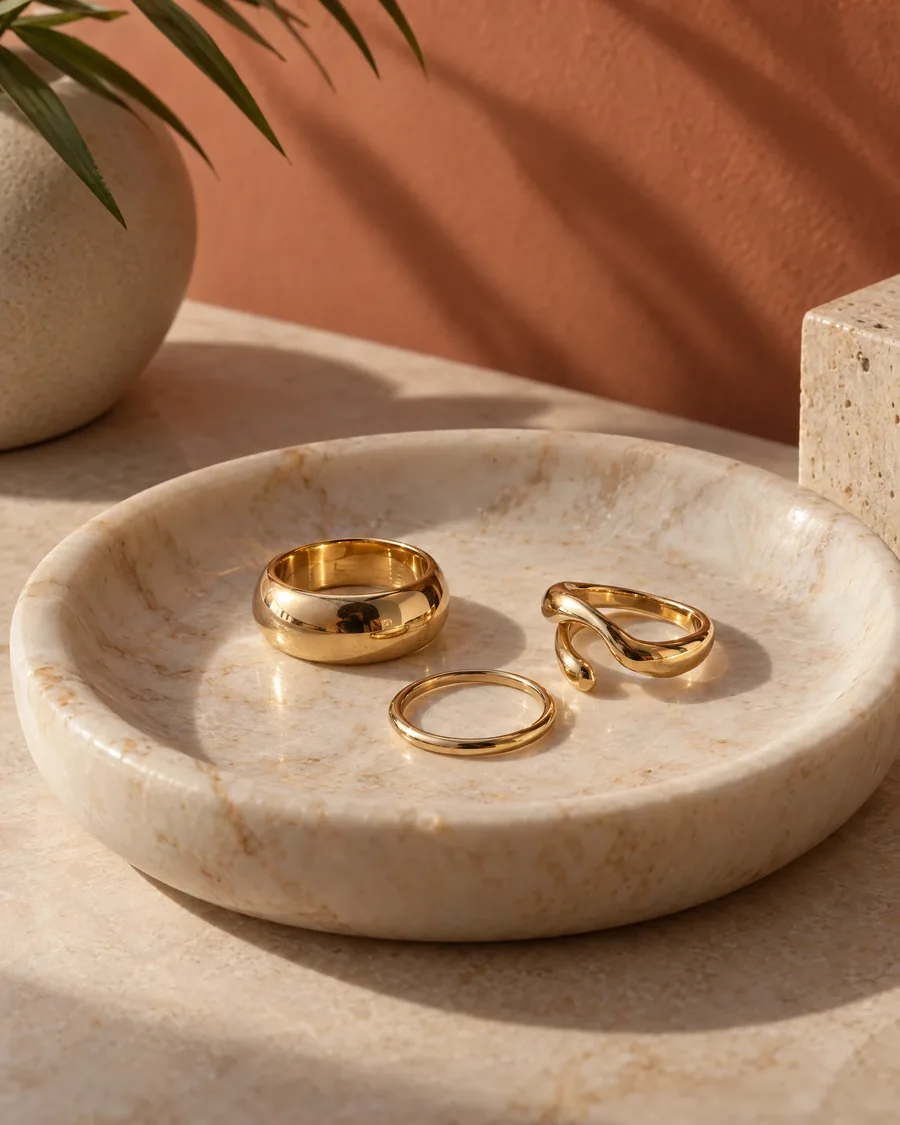
Editorial guidance only. Product characteristics, care needs, and commercial terms should be confirmed in writing for any specific item.
With sculptural jewelry, the outline often does the talking: a folded curve, an angular ridge or an open loop can change how an otherwise familiar outfit reads. Styling it well is less about following rules for bold accessories than understanding the space around a shape. If you are wondering how to style sculptural jewelry with simple clothing, start with what you already wear and decide where you want attention to land. This guide explores silhouette, clothing, placement and movement through practical comparisons you can make in a mirror. The aim is an intentional composition, not a prescribed look or a requirement to wear more.
Read the outline before judging the size
The first useful distinction is between physical size and visual weight. A broad, open ring may occupy plenty of space while appearing lighter than a smaller, solid-looking form. A narrow piece with sharp projections can command attention without much width. When assessing sculptural jewelry, look at its outer boundary, the spaces within it and how far it stands away from the body. Those features explain its presence better than size alone.
Try comparing three kinds of outline: a continuous curve, a geometric block and an irregular folded shape. The curve tends to guide the eye along a line; the block creates a definite stopping point; the fold introduces several directions. These are styling observations rather than universal effects. Against your own clothing, ask whether you want the accessory to soften a straight seam, reinforce a crisp silhouette or introduce an unexpected interruption.
Negative space—the visible gap inside or around a form—is especially useful with sculptural jewelry. An open outline needs enough contrast for its edges to register. Against heavily patterned fabric, that opening may become harder to distinguish; against a quiet background, its structure is clearer. Hold a design near a plain shirt and then near a print. Notice whether you still see the whole shape or mostly separate flashes of its surface.
Explore our product collection for individual designs, photographs, and product details. When considering sculptural jewelry, look at each piece in the context of your own preferences and practical needs. Use the product description to check relevant specifications rather than relying on appearance alone. For a more personal recommendation or a question about a particular piece, contact katherine jewelry with the details that matter to you.
Finish by stepping back from the mirror. Close inspection can exaggerate a detail that barely registers within the whole outfit. Sculptural jewelry should be assessed at both distances: near enough to appreciate its form and far enough to understand its proportion. If you only like the close-up view, adjust the background or placement before rejecting the shape. Sometimes a clearer sleeve edge or quieter neckline is the missing element.
Give simple clothing a deliberate supporting role
A simple outfit is not an empty canvas; its seams, texture and volume already create a structure. To style sculptural jewelry with simple clothing, choose one feature of the garment to work with. A smooth crew neck offers a continuous field, an open shirt collar creates two angled boundaries, and a straight sleeve ends in a clear horizontal line. Decide whether the jewelry will echo that structure or contrast with it.
Consider a white shirt and straight trousers. With the collar open, an angular necklace could repeat the opening, while a rounded pendant could counter it. Neither is inherently better. Try both ideas without changing the rest of the outfit, then check which gives the neckline a clearer purpose. Sculptural jewelry is easier to judge when you change one variable at a time instead of replacing the clothing, shoes and accessories together.
Fabric texture provides another decision rule. If a sweater has a pronounced cable pattern, a complicated jewelry outline may become difficult to read against it. Move the focal point to an exposed hand or ear, or choose a simpler outline. With smooth cotton or a fine knit, a folded or irregular form has more room to register. Let sculptural jewelry provide the complexity when the fabric is quiet; let it provide a clean boundary when the fabric is busy.
Color contrast can change the apparent importance of the same shape. A low-contrast combination may feel integrated, while a strongly contrasting one separates the accessory from its background. Look in ordinary daylight as well as your dressing mirror, since lighting and screens can alter color appearance. The necklace collection concepts offer inspiration for placement, but use your own garments to test the relationship rather than treating a digital image as a reliable color match.
Before adding another accessory, identify the outfit's lead element in one sentence: “The curved ring is the focus,” or “The earrings frame the face.” If that sentence becomes a list, simplify something nearby. This does not mean sculptural jewelry must always be worn alone. It means that a plain outfit benefits from hierarchy: one form leads, another supports, and the clothing keeps their relationship legible rather than competing for the same attention.
Balance hands, wrists and the space near your face
Placement matters as much as the shape itself. Earrings and necklaces occupy neighboring territory, while rings and bracelets share the moving landscape of the hand and wrist. When combining sculptural jewelry, consider distance before matching details. Two expressive pieces can coexist more easily when they have room between them. A strong ring and a modest earring may distribute attention more comfortably than a dramatic necklace directly beneath equally prominent earrings.
Start with the hand if rings are your preferred focal point. Put on one ring, relax your fingers and look at the entire hand rather than isolating the decorated finger. Then add a second piece only if it contributes something distinct. Adjacent broad forms can overlap visually or physically; separating them may give each outline room. There is no requirement to balance both hands symmetrically, and leaving one hand undecorated can make the other feel purposeful.
Height deserves a separate check. A raised ring changes the side profile of the hand and may meet neighboring fingers, cuffs or objects. Professional fitting and the seller's sizing guidance should control a purchase; a styling photograph cannot establish fit. For sculptural jewelry that projects outward, gently make a fist, reach into an empty pocket and hold a bag handle. If the shape interferes, consider a different placement or a less projecting design for that routine.
At the wrist, decide whether the sleeve should frame the piece or cover it. A cuff ending just above a bracelet can create a clear boundary, whereas a loose sleeve may repeatedly slide over it. Near the face, hair and collars perform the same framing role. Explore the earring design ideas to compare open and compact outlines, then test the arrangement with your usual hairstyle. Sculptural jewelry needs to work with the way you actually wear your clothes.
For multiple pieces, repeat one visual quality rather than every detail. A rounded ring could relate to a curved earring without matching its dimensions or surface. Keep the companion quieter through scale, contrast or complexity. The practical test is whether your eye can move between the pieces without becoming stuck in one crowded area. This approach makes coordination flexible: you are building relationships among forms, not trying to assemble an identical set.
Test the composition against the day you will have
A proportion that works in a still photograph may not suit a day at a desk, a commute or an evening meal. Treat movement as the last design test for sculptural jewelry. Sit down, turn your head, bend your wrist and put on any outer layer you will need. Check where the piece shifts or meets fabric. Sculptural jewelry that requires constant adjustment can undermine an otherwise thoughtful outfit, regardless of how striking its shape appears.
For a workday with a headset and frequent typing, place the focal point where it causes the least interference. That might mean choosing a necklace instead of projecting earrings, or leaving a raised ring for another occasion. For dinner, a visible hand piece may come into its own as you gesture across the table. Sculptural jewelry does not need a special-event setting, but its placement should reflect the activities that fill the occasion.
Use a quick wardrobe experiment when you feel uncertain. Photograph the same simple outfit three ways: with one statement piece, with that piece and a quiet companion, and with a different focal point altogether. Keep your stance and lighting similar. Review the full-length images, not cropped accessory shots. This makes it easier to see whether sculptural jewelry clarifies the outfit or introduces unnecessary competition. Choose the version that feels natural as well as visually coherent.
Practical wear also includes knowing when to remove and store a piece. The GIA jewelry care guidance recommends removing jewelry before swimming or household cleaning and keeping items separately padded to reduce scratches. Care depends on the complete construction, not its sculptural appearance. Do not infer materials from a rendering; ask for written details and consult a qualified jeweler when cleaning suitability is uncertain. For questions about this website's concepts, use the katherine jewelry contact page.
The most useful final edit is small: remove one competing detail, expose a little more space or shift the focal point. You do not need a new wardrobe to make sculptural jewelry feel considered. Start with an outline you enjoy, give it a supportive background and check it in motion. Proportion becomes easier when you treat it as a relationship among shape, clothing and daily life—not a fixed rule about who can wear something bold.