Editorial guidance only. Product characteristics, care needs, and commercial terms should be confirmed in writing for any specific item.
Choosing bridal jewelry starts with the dress, but it should end with you: your comfort, your favorite details and the way you want to feel throughout the celebration. A necklace that looks beautiful alone may compete with a lace bodice, while small earrings can disappear beside a dramatic veil. Learning how to choose bridal jewelry for your wedding neckline is less about fixed rules than about proportion. This guide from katherine jewelry offers a practical sequence: read the neckline, choose a focal point, connect the finishes and test everything together before making your final decision.
Read the Neckline Before Choosing a Necklace
Begin with a photograph of yourself wearing the dress, taken straight on at roughly chest height. Notice where the fabric ends and how much uninterrupted skin appears above it. That space is the working area for bridal jewelry, not an empty zone that automatically needs filling. A useful first test is to try the dress without a necklace, then add one and compare the photographs. Keep the option that makes your face and neckline feel clearer, rather than the one that simply adds more decoration.
A strapless or gently curved sweetheart neckline often leaves room for a short necklace, but length matters more than the label. The necklace should sit comfortably inside the open space instead of repeatedly touching the dress edge. With a sharply pointed sweetheart bodice, a curved necklace can soften the outline; a small pendant can echo its center. Neither approach is compulsory. For this style of bridal jewelry, check the view while seated as well as standing, because posture changes the distance between necklace and fabric.
A V-neck offers a clear directional cue. Try a pendant that follows the opening without dropping into the bodice or catching on its trim. A shallow V may need only a compact pendant, whereas a deeper opening gives you more room to experiment with length. Explore necklace design concepts to compare silhouettes, not to assume a particular material or availability. Your bridal jewelry should respect the actual dress construction: if the center is covered in appliqué, a necklace may interrupt rather than reinforce the line.
High necklines, illusion panels and densely embroidered collars often work well without a necklace. Let earrings carry the emphasis instead, especially when the dress already places texture close to your face. With an asymmetric neckline, compare simple studs against a slender drop; a large necklace can create a second diagonal that feels distracting. Choosing bridal jewelry here means deciding which existing line deserves attention, rather than trying to balance every exposed area with another accessory.
Use one final neckline rule: move normally before deciding. Turn your head, lean forward and raise your arms as you might during a greeting. If your bridal jewelry catches, slips beneath the neckline or needs repeated straightening, change its length or remove that piece. A beautiful arrangement should survive ordinary movement.
Choose a Focal Point Around Your Face
Once the neckline is settled, consider the frame around your face: hair, earrings, veil and any comb or headpiece. These elements occupy the same visual neighborhood, so they deserve a shared fitting. Bridal jewelry can provide one strong focal point or several quieter accents, but it rarely needs to make every element equally prominent. If you love a dramatic earring, try reducing necklace detail first. If a sentimental necklace is essential, start with restrained earrings and build outward only if the result feels unfinished.
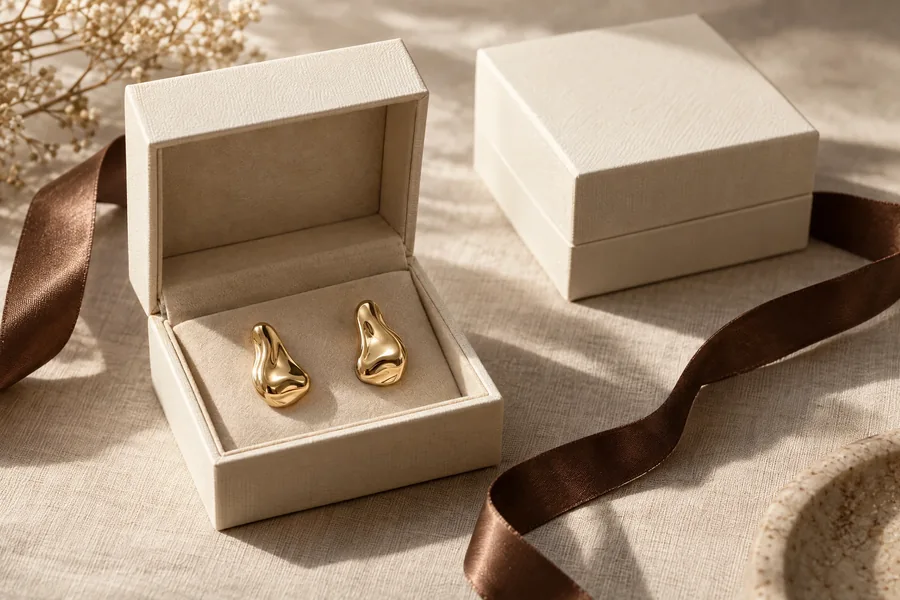
Hair changes how much of an earring is visible. With loose waves, a slightly longer drop may show more reliably than a tiny stud, yet it can also snag in strands. With an updo, a compact design may look more noticeable because nothing obscures it. Browse earring style inspiration with your planned hairstyle in mind. When testing bridal jewelry, photograph both sides of your face: a side part or swept fringe can make the same pair appear quite different from one angle to another.
A veil introduces another layer of texture and movement. An embellished edge near your shoulders may compete with long earrings, while a plain veil leaves more room for detail. Put the veil on during the trial instead of mentally adding it afterward. Test removal, too, if you plan to take it off after the ceremony. Your bridal jewelry should still feel intentional when that frame disappears; an elegant ceremony combination can become unexpectedly bare or overly dominant once the veil is gone.
Scale is better judged in photographs than at a mirror held close to your face. Take one head-and-shoulders image and another from across the room. In the close view, inspect whether shapes overlap awkwardly; in the distant view, see which detail attracts attention first. For example, with a beaded high-neck dress and a jeweled hair comb, small earrings may provide enough finish. Bridal jewelry does not have to remain equally visible in every picture to contribute to the overall look.
Finally, wear the earrings long enough to notice their weight and movement. Walk, talk and turn your head rather than standing still for a quick verdict. If bridal jewelry feels distracting during a quiet fitting, reconsider it before a long celebration. A comfortable alternative is more useful than a striking pair you want to remove immediately.
Connect Pearls, Metals and Meaningful Pieces
Dress color can help you compare finishes, but it should not dictate a rigid formula. Ivory fabric does not require a warm metal, and a bright white dress does not forbid one. Place your options beside the actual fabric in daylight and under lighting similar to your venue. Bridal jewelry works best when the contrast looks deliberate to you. Consider the dress embellishment too: a bodice with cool-looking beads may invite a related finish, while a plain fabric gives you more freedom.
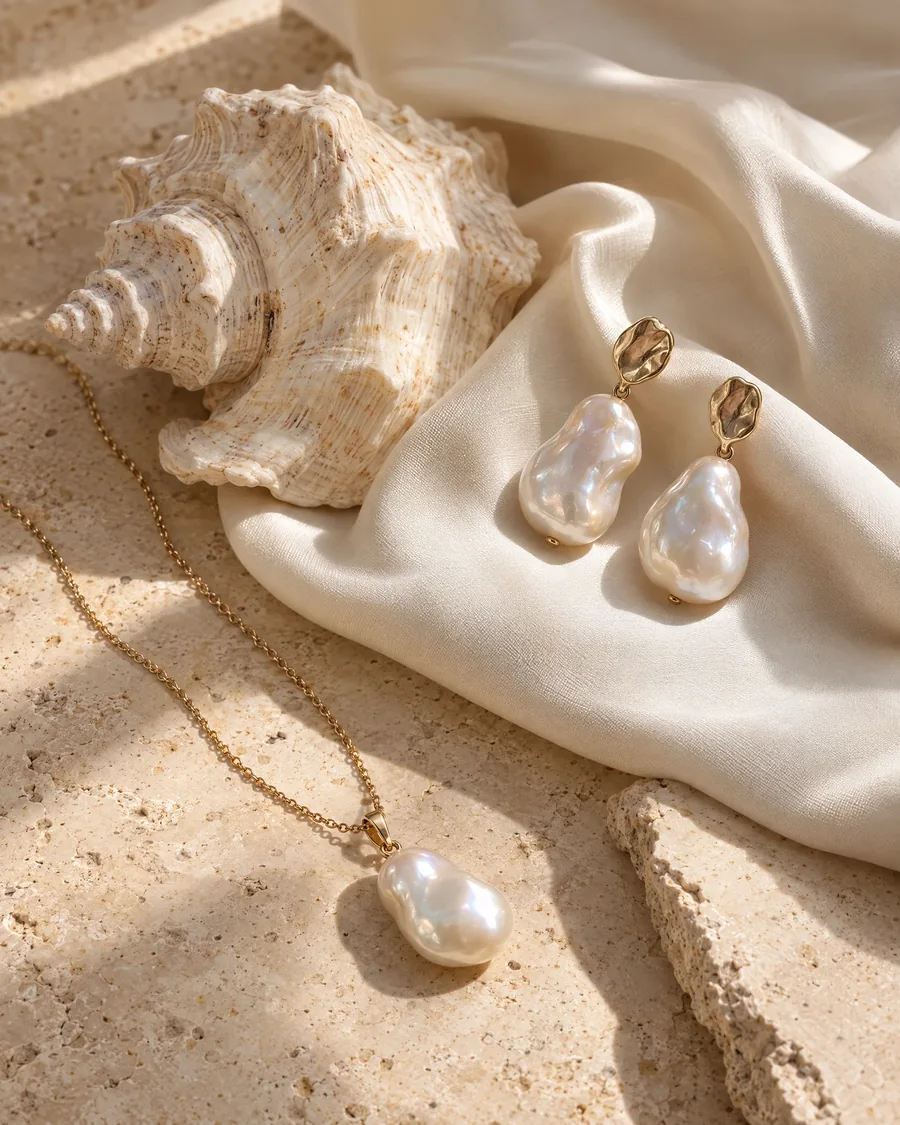
Pearl-inspired designs offer a softer visual rhythm than sharply faceted accents, making them worth considering beside lace, satin or simple tailoring. Compare a single rounded accent with a repeated strand: one creates a small point of interest, while the other draws a continuous line. The pearl design concepts on katherine jewelry are editorial inspiration, not confirmation of merchandise or material identity. When considering bridal jewelry elsewhere, remember that a pearl-like appearance alone does not tell you whether an element is natural, cultured or imitation.
Ask for written material descriptions before purchasing, particularly when photographs are your main reference. The FTC Jewelry Guides address truthful descriptions of metals, gemstones and pearl identity; appearance is not a substitute for those details. For bridal jewelry, clarify the base metal, any plating, stone identity and relevant treatments. These answers help you understand care requirements and compare options fairly, without assuming that similar-looking pieces have the same construction or durability.
An inherited piece can become the anchor rather than an awkward addition. Suppose you want to wear a family pearl necklace with a clean square-neck dress. Try that necklace first, then choose earrings that repeat either its rounded shape or its quiet scale. Avoid matching every feature at once. If your engagement ring has a different metal color, it need not disqualify the combination: bridal jewelry can include mixed finishes when a repeated shape or restrained arrangement makes the choice feel purposeful.
Keep wrist styling connected to practical tasks. A bracelet should not catch on lace cuffs, press uncomfortably against your hand or obstruct the placement of a wedding ring. Try holding a bouquet and resting your hands together. Your bridal jewelry can acknowledge meaningful pieces without surrounding each one with more detail; sometimes leaving a keepsake room to stand alone is the clearest expression of its importance.
Rehearse the Complete Look and Prepare for the Day
Arrange one complete fitting with the dress, undergarments, hairstyle approximation, veil and every accessory you intend to wear. Testing bridal jewelry separately misses small problems that only appear in combination: a clasp beneath a fastening, a pendant against boning or an earring beside a comb. Take front, side and back photographs, then make a short record of your chosen pieces. This becomes a useful reference for whoever helps you dress, especially when several personal items are being transported together.
Build movement into that fitting. Sit for several minutes, hug someone, lift your bouquet and practice any planned change of veil or overskirt. If you expect to dance, try a few turns. Bridal jewelry should remain secure without demanding constant monitoring. Check closures and settings visually, and have a qualified jeweler assess anything loose or uncertain before the wedding. Do not rely on a hurried adjustment on the morning itself, particularly for an inherited piece whose condition you do not know.
Prepare accessories after makeup, perfume and hair products have been applied and allowed to dry. Cosmetics and chemicals can harm some jewelry materials, including pearls. The GIA jewelry care guidance also explains why cleaning methods must suit the complete piece. Avoid last-minute ultrasonic cleaning or aggressive home recipes for bridal jewelry of uncertain construction. Ask a qualified jeweler about appropriate care instead, and keep pieces away from cleaning products, swimming water and unnecessary heat during preparations.
For travel, give each item its own cushioned compartment so hard edges do not rub against other surfaces. Keep pairs together and include a clearly labeled space for any pieces you remove between ceremony and reception. Bridal jewelry is easier to manage when one trusted helper knows the plan. If you want clarification about website imagery or an inquiry, use the contact page rather than treating a pictured design as a confirmed purchasing option. Finish these questions before the final styling rehearsal whenever possible.
Your last decision should be subtraction, not another search. Look at the complete outfit and ask whether anything competes with your favorite feature or makes you uncomfortable. Remove that element and compare again. The right bridal jewelry supports the dress, preserves the meaning of personal pieces and lets you move through the day without fuss. Once that balance feels right, keep the reference photograph, pack carefully and let the chosen look be enough.