Editorial guidance only. Product characteristics, care needs, and commercial terms should be confirmed in writing for any specific item.
Choosing hoop earrings starts with your everyday life, not a rule about which face shape should wear which circle. Size matters, but so do thickness, movement, fastening and the space between the jewelry and your clothes. A pair that looks understated in a photograph can feel surprisingly prominent beside your face.
If you are deciding how to choose hoop earrings for everyday wear, this guide offers four useful checks: measure the outline, choose its visual character, assess the construction and test it against real outfits. Treat each as a way to narrow your options, rather than a prescription for one universally flattering style.
Read size in three dimensions, not diameter alone
Diameter is the first measurement to compare when choosing hoop earrings, but check what it describes. An outside diameter includes the thickness of the hoop; an inside diameter describes the opening. A wide band and a fine wire circle can therefore have the same outside measurement yet leave very different amounts of open space. If a description simply says “size,” ask which dimension is being measured before comparing it with another design.
Build a visual reference with a ruler and a few paper outlines. Try circles approximately 15, 30 and 45 millimeters across as comparison points, not universal definitions of small, medium and large. Hold them beside your ear without attaching them to the piercing. Look straight ahead and turn sideways: the lower edge, width beside your cheek and distance from your collar all affect the impression. Paper helps estimate scale, but cannot reproduce weight or movement.
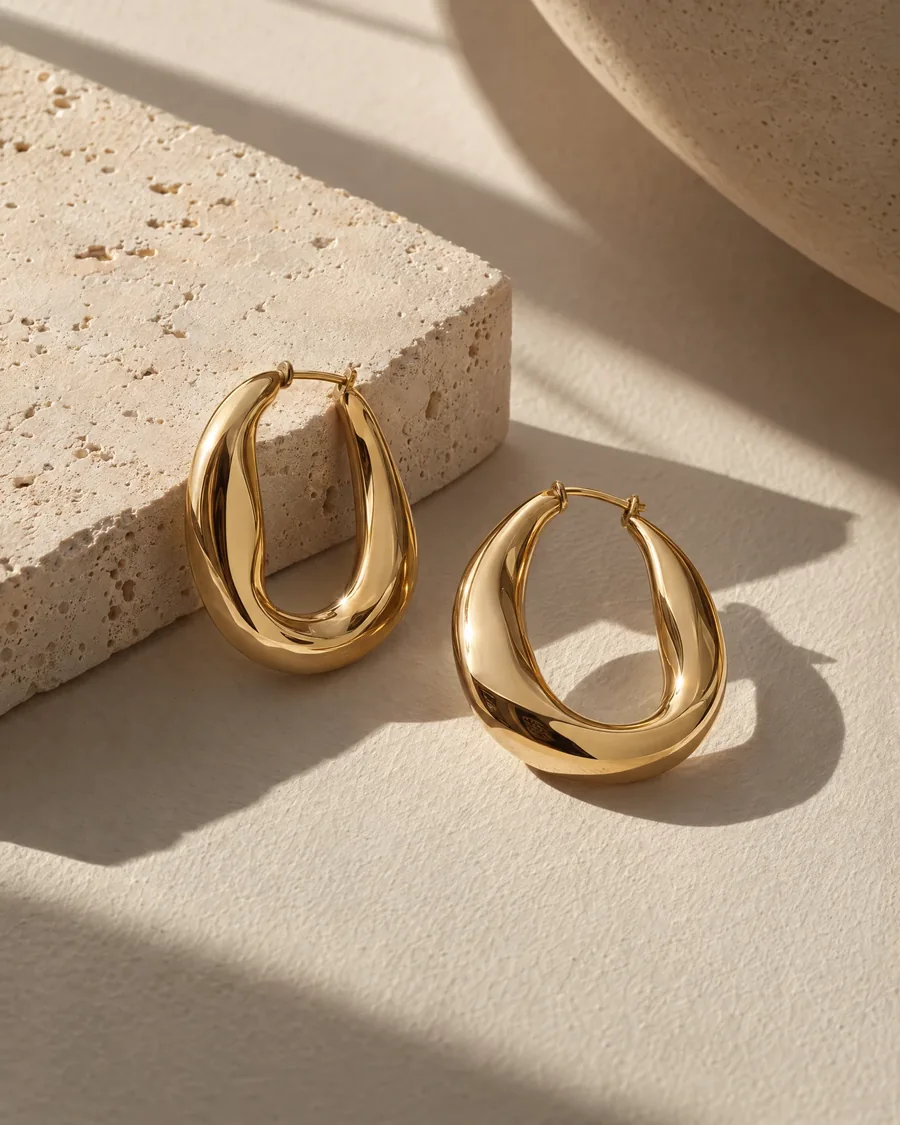
Next, examine profile and depth. Some hoop earrings present a broad front surface, while others show a narrow line from the front and more width from the side. A compact, thick hoop can look bolder than a larger, slender circle. Ask for front and side views when possible, and notice whether the design projects outward. This becomes particularly useful if you wear glasses, over-ear headphones or high collars that occupy the same space.
Separate visible size from wearing weight. Photographs cannot reliably tell you how heavy hoop earrings will feel, and a large silhouette is not automatically heavier than a compact one. Ask for the weight of each earring when available, rather than assuming a listed figure refers to the pair. Compare it with earrings you already wear comfortably. If a design pulls, pinches or becomes distracting, do not treat discomfort as something you must accept for the look.
Finally, match scale to a typical day. For a commute involving scarves and layers, a close outline may be easier to manage; for an evening with an open neckline, a wider circle may have room to move. Browse the earring design concepts to compare proportions, then shortlist hoop earrings using actual measurements. Your best size is the one that gives you the presence you want without repeatedly colliding with your routine.
Choose the silhouette by deciding what should stand out
Shape changes the character of hoop earrings even when their overall dimensions are similar. A round outline emphasizes a continuous curve; an oval introduces a longer vertical line; a squared or irregular outline adds sharper changes of direction. Huggie-style designs sit close to the lobe, though the fit depends on the opening and your piercing placement. Consider these design categories as visual starting points, not promises about comfort or how any particular pair will fit.
Start with the clothes you repeat most often. With plain shirts and uncomplicated necklines, thicker hoop earrings can provide the outfit's main point of interest. If you regularly wear patterned blouses, decorative collars or layered accessories, a slimmer outline may leave those details room to breathe. Neither approach is inherently better. The useful question is whether you want the earrings to lead the outfit or support something you already enjoy wearing.
Hair changes how much of the shape remains visible. Compare your preferred silhouette with your hair down, tucked back and tied up, rather than styling only for a mirror photograph. Fine hoop earrings might disappear behind loose hair, while a broader surface can remain noticeable. Texture also matters visually: a smooth outline feels different from a ridged or twisted one. Choose that contrast deliberately, especially when your hairstyle already creates plenty of movement around the face.
Eyewear offers another practical comparison. Look at the gap between the frames and the earrings, and notice whether their lines overlap from the side. Rounded frames do not require rounded jewelry, and angular frames do not prohibit it. Try one shared detail—similar visual weight, for instance—before attempting to match everything. The sculptural jewelry concepts can help you explore contrasting forms without turning a subjective styling preference into a supposed rule about facial proportions.
Explore our product collection for individual designs, photographs, and product details. When considering hoop earrings, look at each piece in the context of your own preferences and practical needs. Use the product description to check relevant specifications rather than relying on appearance alone. For a more personal recommendation or a question about a particular piece, contact katherine jewelry with the details that matter to you.
Make closures and construction part of the decision
A fastening deserves as much attention as the outline. Common closures on hoop earrings include hinged mechanisms, posts with separate backs and continuous designs that thread through a piercing. These categories explain how an earring operates, but do not establish its security. Ask how the particular closure opens, how it should align when shut and whether there are instructions for handling it. A clear demonstration is more useful than a reassuring description such as “easy to wear.”
Consider your hands and the circumstances in which you get dressed. If you struggle with tiny separate parts, a hinged design may be easier to handle, although individual mechanisms vary. If you put earrings on while rushing out the door, choose something you can operate calmly and consistently. Test hoop earrings over a clear surface so dropped components are easier to find. Do not force a resistant clasp or bend a post to compensate for poor alignment.
Fit at the piercing needs its own check. For close-fitting hoop earrings, the opening must accommodate the distance between your piercing and the edge of your lobe without squeezing it. The visible diameter alone cannot confirm that clearance. Ask about the internal opening and wearable post dimensions if relevant. When trying a pair, notice pressure as well as pulling. Remove jewelry that feels uncomfortable rather than relying on a claim that everyone can wear the same close fit.
Run through everyday interference before committing to a full day's wear. Put on your usual glasses, jacket and scarf, and gently turn your head. Check whether hair catches at the join or the hoop brushes your collar. Headphones can press against jewelry even when nothing snags. Remove earrings for activities where pulling, impact or entanglement is likely, and follow any workplace restrictions. A smaller silhouette may reduce interference, but it does not make every activity suitable for jewelry.
Finally, separate appearance from material identity. A yellow, white or pink finish does not establish the underlying metal, and surface plating is not the same as solid metal throughout. When comparing hoop earrings, request written information about metal content, coatings and any decorative stones. The FTC Jewelry Guides explain the importance of truthful material descriptions. For questions about information on this website, use the contact page; do not infer specifications or allergy guarantees from an image.
Build a rotation that earns its place in your routine
A useful rotation begins with the occasions you actually have, not a checklist of styles you supposedly need. You might prefer one pair of hoop earrings for most days and a more expressive shape for evenings. Alternatively, changing your hairstyle or neckline may provide enough variety with a single pair. Review what you already wear: the missing option could be a quieter outline, a different proportion or simply a closure that is easier to manage.
Use a three-outfit test before adding hoop earrings to your shortlist. Picture your most frequent work outfit, a weekend layer and something you wear to meet friends. For each, consider visibility, collar clearance and which accessory takes the lead. A pair that works with two of those outfits has an obvious role. One that suits only a special look can still be worthwhile, provided you recognize it as an occasional choice rather than an everyday solution.
Keep a brief record after wearing a pair you already own. Note when you put it on, whether it caught on anything and why you eventually removed it. That gives you more useful evidence than remembering only how it looked at the start. When considering new hoop earrings, use those observations to prioritize one improvement. If your current pair disappears behind your hair, you may need a clearer outline—not necessarily a much larger diameter.
Care also belongs in the everyday decision. Remove hoop earrings before swimming or household cleaning, and store pieces separately in padded compartments to limit scratches. Cleaning must suit the complete construction, including coatings, stones and settings. The GIA jewelry-care guidance explains why chemicals, heat and some cleaning equipment can be unsuitable. Do not assume an ultrasonic cleaner is safe for every pair; when materials or treatments are uncertain, seek advice from a qualified jeweler.
The simplest way to choose hoop earrings for everyday wear is to connect each appealing design with a practical reason. Confirm its dimensions, understand its fastening and imagine it alongside clothes you already use. For inspiration from katherine jewelry, keep the distinction between editorial imagery and verified item details clear. The right silhouette need not follow a face-shape formula or make the loudest statement. It should give you the balance of comfort, visibility and personality you want in ordinary life.