Editorial guidance only. Product characteristics, care needs, and commercial terms should be confirmed in writing for any specific item.
The most satisfying ring stacking starts with recognition: you look at your hand and see something that feels like you. That might mean two understated bands, an uneven arrangement across several fingers, or one expressive shape with a quiet companion. None needs to follow a matching-set formula.
If you want ring stacking ideas for a minimalist jewelry wardrobe, begin with the pieces you already enjoy and the situations in which you wear them. These styling experiments from katherine jewelry focus on choosing an anchor, adjusting proportions, checking comfort, and editing with purpose, so that a small selection offers possibilities without becoming complicated.
Find your anchor and give every companion a job
Begin with one ring you would happily wear alone. It could be a plain band, a signet-inspired outline, or a shape with an unusual curve. This anchor makes ring stacking easier because you are responding to something specific instead of assembling an imaginary perfect set. Identify its strongest feature: a broad surface, a fine outline, a noticeable setting, or an irregular shape. That feature becomes your starting point for the next decision.
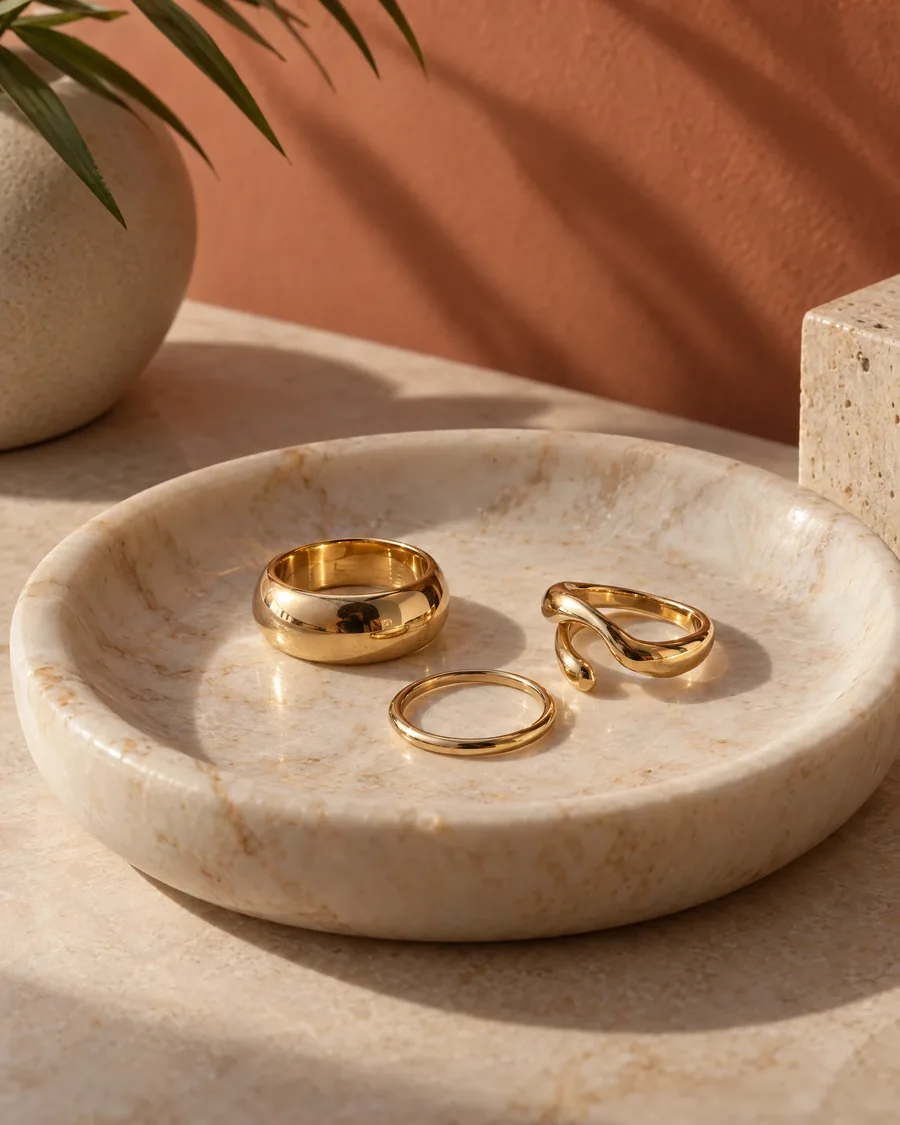
Give the companion a clear job. A narrow band might underline the anchor’s width; a textured design might interrupt an otherwise smooth arrangement. If both rings demand attention for the same reason, try separating them across fingers. For intentional ring stacking, you do not need every piece to be subtle, but it helps to decide which one should register first. Imagine introducing the arrangement in a sentence: “a bold shape with a simple outline beside it.”
Explore our product collection for individual designs, photographs, and product details. When considering ring stacking, look at each piece in the context of your own preferences and practical needs. Use the product description to check relevant specifications rather than relying on appearance alone. For a more personal recommendation or a question about a particular piece, contact katherine jewelry with the details that matter to you.
Try a three-way experiment with your anchor: wear it alone, beside one companion, then with that companion on another finger. Compare the arrangements with your hand relaxed, not only posed for a photograph. In ring stacking, placement can change the character of the same two pieces surprisingly clearly. A close pair may read as a single unit, while separating them lets each shape keep its identity. Choose the version you notice pleasantly rather than constantly.
Finish this first experiment by naming what worked. Perhaps you liked a quiet ring next to an expressive one, or discovered that you prefer open space around your anchor. Write a short note or save a photograph for your own reference. This gives future ring stacking a useful direction without making your taste rigid. You are collecting evidence about your preferences, not creating a formula that every later arrangement must obey.
Compose the whole hand with proportion and breathing room
Once you have an anchor, step back and consider the whole hand. Visual weight comes from more than width: a tall profile, strong color contrast, or detailed surface can also draw attention. For balanced ring stacking, try pairing one visually substantial piece with a quieter outline before adding a third. This is an editorial starting point, not a universal beauty rule. If you enjoy a denser arrangement, you can still make its hierarchy deliberate.
Use empty space as part of the composition. Leave an unadorned finger beside a busy stack, or keep one hand mostly clear when the other carries your focal point. Ring stacking does not require symmetrical hands or jewelry on every finger. For example, two bands on one finger and a separate ring elsewhere can create a loose rhythm without filling every gap. If the arrangement feels crowded, move a piece before assuming you need a smaller design.
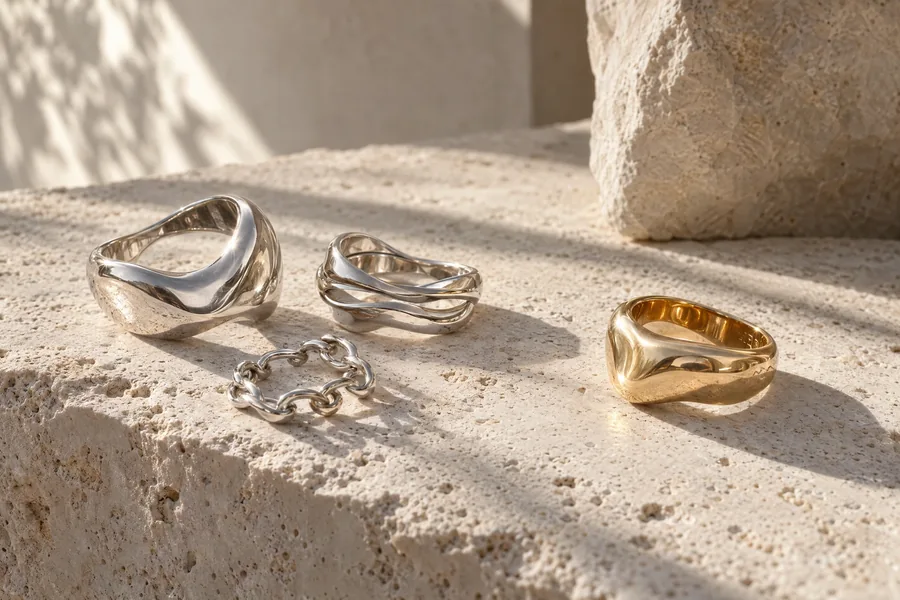
Look for a visual connection when combining different styles. A shared curve can link a plain band and a sculptural outline; a repeated finish can connect otherwise unrelated shapes. Mixed color appearances can also feel considered when one color leads and another acts as an accent. Do not infer actual metal content from appearance, however. The FTC Jewelry Guides support truthful material descriptions; when considering a purchase, ask for written details rather than treating a photograph as proof.
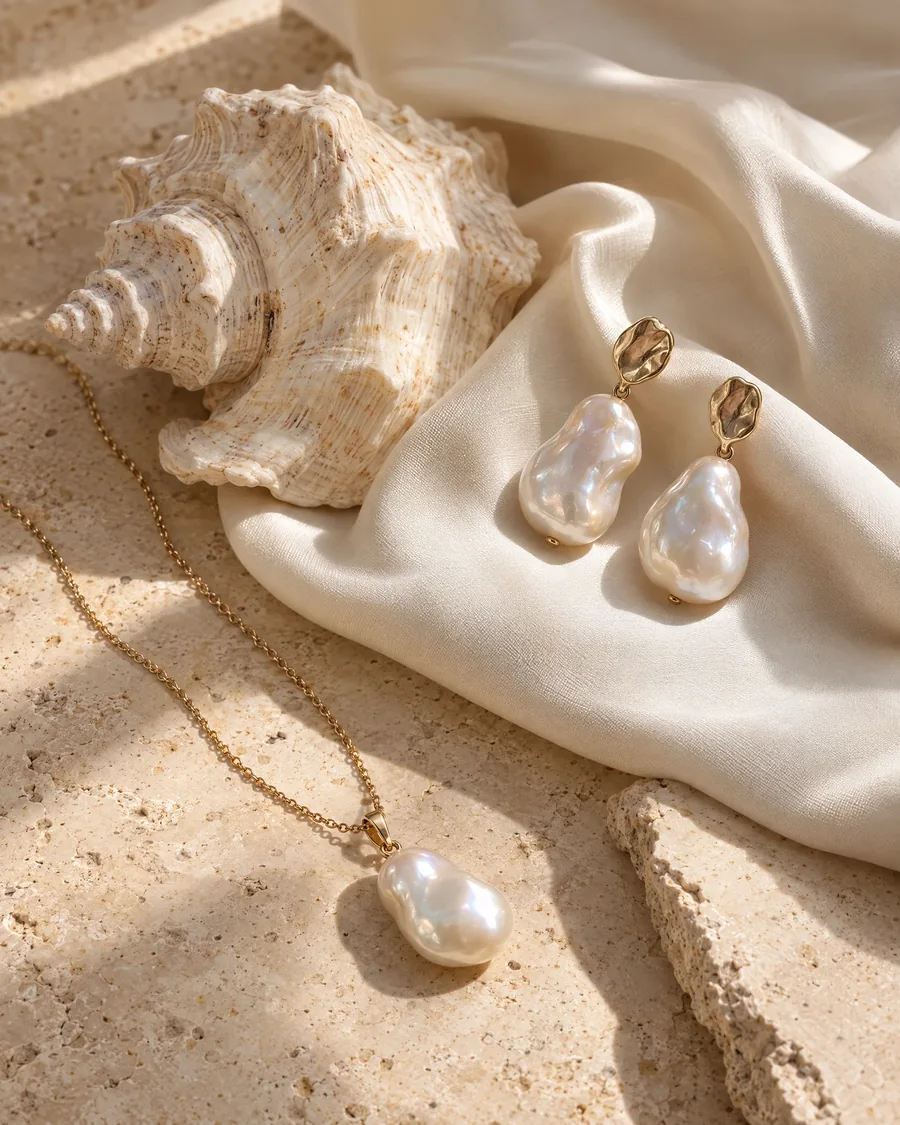
Check your arrangement against the rest of your jewelry and clothing. With patterned sleeves or a prominent bracelet, you may prefer simpler ring stacking; with a plain shirt, a more expressive hand arrangement might feel welcome. Neither choice is more correct. The earring design concepts offer another way to think about scale: a noticeable earring and a noticeable ring can coexist, but they do not both need several supporting pieces around them.
For a practical comparison, photograph three versions under similar lighting: concentrated on one finger, spread across neighboring fingers, and divided between hands. Keep the same rings so you are testing placement rather than changing every variable. Notice where your eye lands and whether that matches your intention. This small exercise makes ring stacking decisions clearer: you may discover that the arrangement needs more breathing room, not another matching band or a completely different aesthetic.
Test the arrangement against your actual day
A convincing arrangement should work when your hands are doing something, not just resting for a picture. Test ring stacking during a short stretch of ordinary activity: type a paragraph, fasten a jacket, or hold your usual bag. Notice pressure between neighboring fingers, slipping, and snagging. A design you love may suit occasional wear better than a busy working day. That is a useful distinction, not a reason to dismiss the piece or your taste.
Try the complete combination when assessing fit. Several bands together can feel different from each worn separately, particularly when they occupy more of the finger. Rings should not cause painful pressure or feel insecure enough that you worry about losing them. Ring stacking is not a substitute for appropriate sizing: general guides are approximate, and seller sizing tables and professional fitting should guide purchases. If adding a companion changes comfort, reduce the stack rather than tolerating the problem.
Check neighboring profiles as well as finger fit. One setting may extend over another band, while two raised designs may knock together during movement. Do not force rings to sit flush when their construction does not allow it. Moving one to another finger can preserve the look without constant contact. For everyday ring stacking, a useful decision rule is simple: if you repeatedly adjust the arrangement or protect your hand from normal movement, simplify it for that activity.
Let your routine determine when to take rings off. Remove jewelry before swimming or household cleaning, as advised in GIA’s jewelry care guidance; chemicals can harm materials, and care depends on the complete construction. Store pieces separately with padding to reduce scratches rather than dropping them together into a loose pile. If materials or treatments are uncertain, consult a qualified jeweler about cleaning instead of applying an aggressive recipe to everything.
Build two versions of a favorite arrangement: a pared-back daytime option and a fuller version for a quieter occasion. Keep the anchor if it remains comfortable, and change only its companions. This lets ring stacking adapt without requiring a large wardrobe. Give removed pieces a secure, consistent resting place at home and separate cushioned compartments when traveling. A small routine supports the styling habit by making it easier to return to your preferred combination without searching for missing rings.
Build a small rotation and edit toward your own signature
Lay out the rings you already own and group them by visual role rather than assumed material: anchors, quiet companions, and occasional accents. Some will belong in more than one group. This turns ring stacking into a wardrobe exercise instead of an automatic shopping list. A ring that looks awkward beside one anchor may be exactly right beside another, while a strong standalone design may never need a companion. Leave room for both possibilities in your rotation.
Create three arrangements with distinct purposes: your easiest everyday pair, a more expressive combination, and an almost-bare option. Reuse pieces between them rather than seeking separate sets. These are practical ring stacking ideas for a minimalist jewelry wardrobe because variety comes from placement and emphasis, not simply from quantity. For example, the same band can sit beside an anchor one day and on the opposite hand another day, changing the balance without introducing anything new.
Apply an editing test before keeping a combination: remove one ring and compare. Does the arrangement become clearer, or does it lose something you value? Put the ring back only if you can identify its contribution, whether that is contrast, rhythm, or personal meaning. Thoughtful ring stacking need not look sparse, but each addition should earn its place. If two combinations work equally well, keep the one that is easier to wear for the occasion you have in mind.
When you do identify a genuine gap, describe it narrowly before exploring options. “A low-profile companion with a simple outline” is more useful than “something to finish every stack.” Browse the sculptural design concepts if shape is the missing element, or use the katherine jewelry inquiry page for questions about website concepts and any actual details requiring confirmation. Styling inspiration cannot establish composition, sizing, or availability, so keep those questions separate from your visual wish list.
Your signature will emerge through repetition: perhaps you favor uneven spacing, a single strong anchor, or a quiet pair that rarely changes. Let those preferences guide ring stacking without turning them into obligations. Return to what feels comfortable, change one variable when you want a fresh direction, and stop when the arrangement feels complete to you. The goal is not to demonstrate how many rings you can combine, but to make the pieces you choose feel at home on your hands.