Editorial guidance only. Product characteristics, care needs, and commercial terms should be confirmed in writing for any specific item.
A jewelry assortment is more than a group of attractive pieces: it is a set of choices that helps customers understand your boutique. When the selection has a clear point of view, shoppers can compare designs, find complementary pieces and see why each belongs. This jewelry assortment planning guide for independent boutiques starts with customer needs rather than a buying wishlist. It then connects visual direction, category coverage, supplier questions and stock review. For readers exploring katherine jewelry, the examples below are planning tools and design inspiration, not statements about available merchandise, wholesale terms or the materials shown in website imagery.
Define the Customer and the Boundaries of Your Edit
Start by describing the shopping situation your boutique serves, not simply a customer’s age or taste. Is someone choosing a small gift during a lunch break, finding an accessory for an occasion or replacing an everyday favorite? A useful jewelry assortment answers recognizable needs. Review recent customer questions and purchase combinations, then write a one-sentence brief such as: “Easy-to-coordinate accessories for customers who want a polished look without a complicated styling decision.”
Turn that brief into three design boundaries. You might choose restrained silhouettes, a narrow color palette and a consistent visual scale. These are editorial choices, not evidence that particular materials are available. Your jewelry assortment should still contain contrast: a quiet design can sit beside a more expressive one if both share a recognizable line or proportion. Reject pieces that require a different explanation of what the boutique stands for, even when they are individually appealing.
Next, identify gaps in how customers can shop. A boutique may have many dramatic earrings but little for someone seeking a subtle finishing touch. Another may offer several delicate necklaces that look nearly identical at display distance. Sketch the jewelry assortment by customer task: understated daily dressing, noticeable accents and gifting. Record which task each proposed design serves. If several options solve the same problem in the same way, consider whether that duplication earns its space.
Explore our product collection for individual designs, photographs, and product details. When considering jewelry assortment, look at each piece in the context of your own preferences and practical needs. Use the product description to check relevant specifications rather than relying on appearance alone. For a more personal recommendation or a question about a particular piece, contact katherine jewelry with the details that matter to you.
Finally, set a simple exclusion rule before reviewing more designs. Perhaps you will avoid introducing another visual theme until an existing one demonstrates demand, or decline pieces that lack adequate written specifications. This prevents enthusiasm from expanding the jewelry assortment beyond its purpose. Ask a colleague to test the brief against five proposed additions. If they cannot explain how each serves the intended customer, revise the selection or make the brief more precise.
Balance Categories, Choice and Display Space
Once the customer brief is clear, build a category map rather than buying equal quantities of everything. Earrings, necklaces, bracelets and rings create different comparison and fitting tasks. A balanced jewelry assortment does not need equal representation across these categories; it needs enough coverage to support the way your customers shop. List each category alongside its intended role, available display space and practical requirements, including size variation, storage and staff explanation.
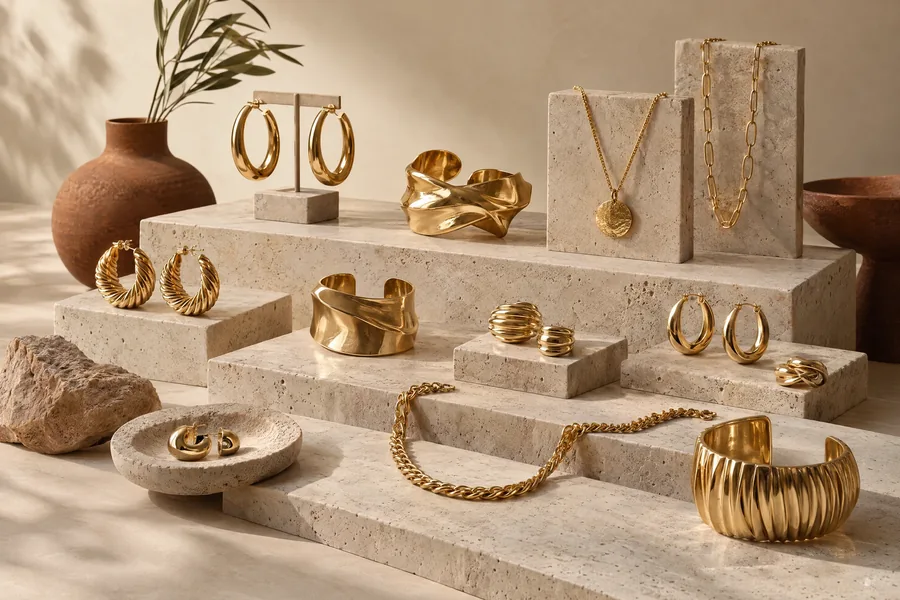
Separate breadth from depth. Breadth is the number of distinct choices; depth is the quantity held within a choice. A jewelry assortment with many similar designs can consume attention without offering meaningful variety. Imagine a compact counter with room for twelve clearly presented options: four contrasting silhouettes may communicate more effectively than twelve slight variations. Use a hypothetical layout first, then adjust the selection to your actual fixture dimensions and safe handling needs.
Create a matrix using categories on one axis and styling roles on the other. Mark everyday anchors, expressive accents and gift-friendly choices, but do not force a purchase into every box. Your jewelry assortment may intentionally omit a role that does not suit the boutique. Exploring necklace design inspiration alongside bracelet concepts can help you see whether complementary proportions create a credible styling story, without assuming those examples can be ordered.
Build budget bands from confirmed costs and your own retail economics, not appearance. Account for freight, packaging, payment charges and other applicable expenses before deciding what a piece can support financially. The jewelry assortment should provide understandable differences between options, with factual explanations where materials or construction affect cost. Do not label an item “premium” solely because it looks substantial. If reliable pricing information is unavailable, leave the budget cell provisional rather than inventing a number.
Test the arrangement as a shopper would encounter it. Can someone identify a quiet option, a statement option and a plausible companion piece without moving several displays? Does the ring area make sizing questions easy to handle? Professional fitting and seller sizing tables should govern purchases; approximate guides are not guarantees. Photograph the mock display and remove anything that blurs the story. A cohesive jewelry assortment often improves through clearer spacing and fewer competing choices, rather than additional designs.
Verify Supplier Details Before Committing
A visually coherent plan is only one part of buying well. Before committing to a jewelry assortment, request written information for each proposed item: base material, surface finish or coating, stone identity where applicable, dimensions, fastening method and relevant care guidance. Ask suppliers to distinguish natural, cultured, laboratory-created and imitation materials accurately. A photograph can help you judge design direction, but it cannot establish metal content, gemstone identity or durability.
The FTC Jewelry Guides provide a useful reference for truthful descriptions of materials, treatments, production, price and value. Apply that discipline to your jewelry assortment records and customer-facing labels. Plating is not the same as solid metal throughout, and laboratory-created does not mean imitation. Where a description is ambiguous, seek clarification before publishing it. Do not replace missing evidence with familiar-looking terminology or a claim copied from another retailer.
Keep commercial questions separate from material questions. For every jewelry assortment proposal, confirm order requirements, quoted prices, payment arrangements, delivery estimates, item identifiers and any agreed procedure for discrepancies or damaged goods. Ask whether repeat orders are possible and how changes would be communicated, rather than assuming continuity. If approaching katherine jewelry, use the wholesale inquiry page as a starting point; actual terms and any available arrangements require a written quotation.
Care requirements also affect whether a design fits your store’s service model. The GIA jewelry care guidance explains why chemicals, heat and cleaning methods can pose risks depending on materials and construction. For a jewelry assortment containing different finishes or stones, avoid one universal cleaning instruction. Ultrasonic cleaning is not suitable for every piece, and vibration can loosen settings. When details are uncertain, seek advice from a qualified jeweler rather than suggesting aggressive home treatments.
Bring these answers into a simple item record that staff can consult during a sale. Include the verified description, care notes, quote reference and unresolved questions. Flag missing information rather than hiding it in a general disclaimer. The jewelry assortment is ready for a buying decision only when the commercial offer and the product description are both clear enough to evaluate. For unanswered brand-specific questions, the contact page provides an inquiry route, not a promise of particular services.
Review Performance Without Losing Your Point of View
After introducing a selection, review it through both sales and customer behavior. Units sold matter, but so do repeated questions, handling, requests for alternatives and purchases made together. A jewelry assortment can look unsuccessful when the real obstacle is an unclear label or inaccessible display. Keep a short observation log so you can distinguish weak demand from presentation problems. Record the item, the customer’s question and any action taken, without collecting unnecessary personal information.
Choose a review interval appropriate to your store’s traffic and buying cycle, then compare items over similar periods. Avoid judging a newly introduced piece against one displayed for much longer. For the jewelry assortment, note units received, units sold and remaining stock, alongside any changes in placement or description. If traffic is low, treat small differences cautiously. One sale or one enthusiastic comment is a signal to investigate, not proof that a whole category deserves expansion.
Use distinct rules for replenishing, testing and retiring designs. Replenish when demand is supported by your records and current written terms remain acceptable. Test an uncertain item by improving its explanation or placement before increasing commitment. Retire a design when it repeatedly fails to serve the customer brief and reasonable presentation changes have not helped. This keeps jewelry assortment decisions consistent, while leaving room for judgment about seasonality, occasional gifting and the value of a distinctive display anchor.
When customers request something outside the edit, look for the underlying need before adding another category. A request for a bigger necklace might actually mean the current display lacks an obvious focal piece. Several requests for smaller earrings could reveal a scale gap within an otherwise strong jewelry assortment. Change one variable at a time where practical, such as silhouette breadth or display grouping, so the next review can tell you more about what made a difference.
Close each review with a written decision: retain, clarify, test, replenish or remove. Update the customer brief only when evidence suggests the boutique’s needs have changed, not whenever a new image catches your attention. The strongest jewelry assortment is neither frozen nor constantly reinvented. It has a recognizable identity, verified descriptions and a manageable process for learning. Start with a focused selection, document the unanswered questions and let thoughtful observation guide the next buying conversation.