Editorial guidance only. Product characteristics, care needs, and commercial terms should be confirmed in writing for any specific item.
Choosing jewelry materials when your skin is sensitive starts with information, not a reassuring label. A silver-colored surface, a familiar hallmark or the word “hypoallergenic” cannot tell you everything about an item's construction or your individual response. The useful questions concern what touches your skin, what sits beneath a coating and how the piece will be worn and cleaned.
This guide explores jewelry materials questions to ask when skin is sensitive, from earring backs to ring interiors. It is general education from katherine jewelry, not a statement about specific merchandise or a substitute for advice from a healthcare professional about a skin reaction.
Start With Composition, Not Color or Reassuring Labels
The first question about jewelry materials is simple: “What is this piece made of, component by component?” Ask for the main metal, its alloy description and any surface finish in writing. An alloy combines metals, so naming only the dominant metal leaves gaps. If you already know that you react to a particular ingredient, that missing information matters more than whether the piece looks delicate, substantial or expensive.
Sterling silver is normally described as 92.5% silver, with other metals making up the remainder. That definition is useful, but it does not identify every alloy ingredient or every component attached to a piece. When comparing jewelry materials, ask what the remaining alloy contains rather than assuming that “sterling” answers the whole question. Silver-colored jewelry, meanwhile, cannot be identified as sterling simply from a photograph or polished appearance.
Gold descriptions also need context: an item described by a gold purity is not the same construction as an item carrying a gold-colored surface layer. Similarly, broad terms such as “steel” may leave the particular alloy unspecified. Your jewelry materials checklist should separate the base metal, alloy and finish. If nickel is a known concern for you, ask specifically about its presence rather than relying on a general comfort claim.
Words such as “hypoallergenic” can sound conclusive, but they are not a personal guarantee that a reaction will never occur. Ask what documented composition supports the description and whether the answer covers the entire item. The FTC's Jewelry Guides explain the importance of truthful material representations. For jewelry materials, a precise written answer gives you more to evaluate than an unexplained badge or a verbal assurance.
Imagine choosing between two similarly colored bands: one has a detailed alloy description, while the other is labeled only “premium metal.” The sensible decision rule is not that the first must suit everyone; it is that the second needs clarification. Use the contact page to ask about an illustrated concept, but keep jewelry materials questions separate from assumptions about availability. If details remain unknown, pause rather than filling the gaps yourself.
Map Every Contact Point, Including the Parts You Rarely See
A piece of jewelry is often an assembly rather than one continuous material. Earrings can include posts, decorative fronts, connecting rings and removable backs; necklaces can have a chain, pendant, clasp and extender. Asking about jewelry materials only for the visible centerpiece can miss the part that rests against your skin all day. Begin by identifying every contact point, then request the composition of each separately.
For earrings, ask whether the post and back have the same composition as the decorative body. Also ask whether replacement backs have their own material specifications: a comfortable front does not establish the suitability of a different backing. The earring design concepts can help you compare shapes and attachment styles, but imagery cannot establish jewelry materials. A clear photograph shows a design; a written specification addresses its construction.
Necklaces create a different contact map. The clasp may sit at the nape, a pendant may lie against the chest and an extender may touch skin beyond the main chain. With jewelry materials, it helps to ask where finishes or components change along the piece. If a seller provides details for the chain alone, follow up about the clasp, pendant fittings and any decorative elements before treating the answer as complete.
Rings and bracelets bring movement, fit and trapped moisture into the picture. A tight band, an edge that rubs or a bracelet worn under a damp sleeve can be uncomfortable without proving that an allergy is responsible. Comparing jewelry materials should therefore include practical construction questions: is the inside smooth, are there recesses that retain soap, and can the piece be removed easily? Use professional fitting and the seller's sizing guidance rather than guessing from appearance.
A useful exercise is to draw a quick contact map before making an inquiry. For a bracelet, mark the inner links, clasp and any charm backs; for a ring, mark the inner shank and areas beneath a broad setting. Browsing ring design inspiration can reveal which shapes need closer questions. Record jewelry materials beside each contact point, and leave unanswered spaces visibly blank instead of assuming every part matches the main body.
Ask How Coatings, Wear and Care Change the Picture
Plating describes a surface layer, not identical metal throughout the object. A coated piece may therefore present a different contact surface as that layer wears. When assessing jewelry materials, ask both what the coating is and what lies underneath it. Follow with a practical question: what care instructions apply to this exact construction? The answer should consider the metal, finish, stones and settings together rather than treating them as independent details.
Wear is not uniform across a piece. Ring interiors, bracelet clasps and raised edges may experience repeated rubbing, while a pendant worn over clothing has a different pattern of contact. Do not assume a coating will remain unchanged indefinitely or predict its lifespan from an image. For jewelry materials with layered construction, ask what visible changes should prompt inspection and whether a jeweler can assess worn areas before you resume wearing the item.
Cleaning should not become an experiment intended to make an uncertain piece “safe.” Avoid aggressive household recipes, abrasive scrubbing or strong chemicals when the construction is unknown. The GIA's jewelry care guidance notes that cosmetics and household chemicals can harm metals and certain gem materials. Cleaning advice for jewelry materials must account for the complete piece; instructions suitable for an unadorned metal object may not suit one with pearls, treatments or delicate settings.
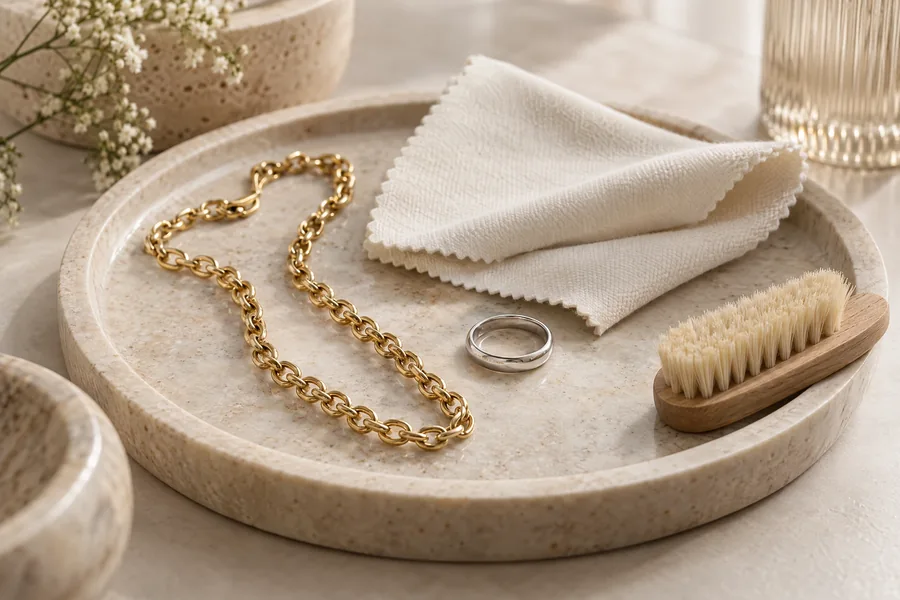
Ultrasonic cleaning is another question, not a universal recommendation. GIA advises caution for organic materials, surface-filled stones and numerous temperature-sensitive gems, and vibration can loosen settings. Ask a qualified jeweler to assess suitability when you are unsure. Day-to-day care of jewelry materials can start more simply: remove jewelry before swimming or household cleaning, follow item-specific instructions, and store pieces separately with padding to prevent contact scratches.
Consider a coated ring worn for commuting, handwashing and desk work. Rather than buying an improvised sealant or continuing through discomfort, remove it when irritation appears and investigate its construction and condition. Ask whether residue, damaged edges or a worn finish need professional assessment. Your jewelry materials notes should include care requirements you can realistically follow. A design needing attention you cannot provide may be an impractical choice, regardless of its visual appeal.
Build a Written Decision Record and Know When to Pause
Turn your questions into a short record you can revisit. List the item or concept, all skin-contact components, stated alloy ingredients, coatings, care instructions and unanswered questions. Save the seller's written responses rather than relying on memory. This makes comparisons between jewelry materials more useful: you can distinguish a clearly specified construction from one supported only by broad descriptions, without pretending that either predicts an individual's response with certainty.
Keep your own observations separate from material facts. Note where discomfort occurred, how long you wore the piece and whether sweat, friction or cleaning products were involved. Such notes may help a healthcare professional understand the situation, but they do not diagnose an allergy. When skin reacts, stop wearing the item rather than repeatedly testing it against irritated skin. A home wear trial cannot certify jewelry materials as suitable or rule out a problem.
Seek medical advice for a persistent or recurring reaction, and obtain prompt care for severe symptoms. If you have a known diagnosed sensitivity, use that information to frame specific composition questions; do not replace it with a marketing promise. A qualified jeweler can help identify construction and assess damage, while a healthcare professional addresses symptoms and possible causes. Understanding jewelry materials is useful, but those two areas of expertise answer different questions.
Explore our product collection for individual designs, photographs, and product details. When considering jewelry materials, look at each piece in the context of your own preferences and practical needs. Use the product description to check relevant specifications rather than relying on appearance alone. For a more personal recommendation or a question about a particular piece, contact katherine jewelry with the details that matter to you.
The final decision can be straightforward: proceed only when you have enough reliable information to compare the construction with your known needs and care habits; otherwise, pause. No attractive finish, reassuring label or familiar metal name removes individual uncertainty. Asking better questions about jewelry materials gives you a clearer basis for choosing, maintaining or declining a piece. The goal is not a promised reaction-free purchase, but an informed choice with honest limits and a plan if discomfort develops.