Editorial guidance only. Product characteristics, care needs, and commercial terms should be confirmed in writing for any specific item.
Good jewelry storage starts with a simple rule: pieces should not rub, snag or press against one another while they rest. A beautiful box is useful only if its compartments suit what you put inside. The most effective jewelry storage ideas to prevent scratches and tangled chains combine soft separation with habits you can repeat, even on a rushed evening.
This guide from katherine jewelry focuses on arranging the pieces you already own, rather than buying an elaborate organizer. From choosing a drawer to packing a travel case, thoughtful jewelry storage gives every item a clear place and makes potential problems easier to notice.
Create a storage layout that matches your daily routine
Begin where you usually remove your jewelry. If pieces accumulate beside the bathroom sink, move the landing place to a nearby bedroom drawer or stable dresser surface instead. Keep it away from water, cosmetics and cleaning products. Convenient jewelry storage should shorten the distance between taking something off and putting it away safely, without placing it beside a drain or on an easily knocked edge.
Empty your existing container onto a clean, soft surface and sort by shape and frequency of wear. Put daily earrings in paired compartments, rings in individual slots that fit without pressure, and bracelets in spaces large enough to avoid bending them. Reserve extra room for projecting settings. A useful jewelry storage layout lets you lift one item without shifting three others; if you cannot, add another compartment rather than stacking pieces.
Choose liners and pouches with smooth interiors, and check for exposed staples, rough seams or abrasive edges. Padding reduces contact, but it does not compensate for overcrowding. Test the box with its lid closed: a tall ring or sculptural earring should not meet resistance. You can use the earring design concepts and bracelet design concepts as prompts for thinking about shapes, not as evidence of materials or availability.
Location matters as much as compartments. For many pieces, a room-temperature drawer away from direct sunlight, radiators and steam is a sensible starting point. However, jewelry storage conditions must accommodate exceptions, including pearls and opals, which should not be kept excessively dry. The GIA jewelry-care guidance explains how light, heat, temperature changes and chemicals can affect different materials.
Finish with a small maintenance rule: keep one clearly marked padded space for pieces needing attention. A loose clasp should not disappear among ready-to-wear items. Keep material descriptions and care instructions nearby, either in an envelope or a simple digital record. Review your jewelry storage whenever retrieving something becomes awkward. The goal is not a perfectly arranged display; it is an arrangement that stays protective when you are tired, distracted or dressing quickly. Leave an empty compartment available so a newly added piece does not immediately upset the system.
Give chains space without creating new snag points
Necklaces need a different approach from compact rings or studs. Fasten each clasp before storing the chain, then lay it in its own long compartment with a gentle curve. Closing the clasp reduces loose ends, though it cannot prevent every knot. For chain-focused jewelry storage, the crucial step is keeping necklaces apart: two neatly arranged chains can still entangle if they slide into the same space.
Choose between hanging and laying flat according to the construction. A separate hook can suit a lightweight everyday chain if nothing catches on it and neighboring pieces cannot touch. Heavy pendants, delicate strands or pieces that appear strained when suspended are better laid flat with their weight supported. Open stands also expose jewelry to dust and light, so place them away from windows. Covered jewelry storage is often more practical for pieces worn only occasionally.
Long necklaces do not need to be folded tightly to fit a box. Arrange a broad oval or a few relaxed curves, making sure the links are not trapped beneath the pendant. In a pouch, avoid pushing several chains together simply because they belong to one layered outfit. Store each separately and group the pouches instead. This approach to jewelry storage preserves your styling combinations without turning them into a single bundle of moving links.
If you discover a tangle, stop before pulling the ends apart. Place the chain on a clean, flat surface under good light and gently ease loose outer loops with your fingertips. Open the clasp if that creates more room. Do not add household oils or powders when you do not know the materials or finishes. A tight knot, bent link or fragile chain is a reason to consult a jeweler rather than keep manipulating it.
Make retrieval part of the plan, too. Position clasps where you can see them and leave enough room to lift a pendant without dragging its chain across another item. The necklace design concepts offer visual examples of silhouettes that may need different amounts of space; they do not identify actual materials. Check your jewelry storage after a week of use. If chains keep migrating or catching, change the compartment shape or give them individual pouches rather than relying on more careful handling alone.
Separate by care needs, not just by appearance
Two similar-looking pieces may require different treatment. A bright metal surface might be plated rather than the same metal throughout, and a gemstone's appearance does not reveal every treatment. Before choosing material-specific jewelry storage, look for written details supplied with your own piece. The FTC Jewelry Guides address accurate descriptions of metals, gemstones and treatments; color and shine alone are not a reliable identification method.
For confirmed sterling silver, anti-tarnish storage can be useful alongside individual padding. Use storage products according to their instructions, and keep pieces clean and dry using care methods appropriate to their construction. Do not apply that arrangement automatically to everything in the drawer. Pearls and opals should not be kept excessively dry, so a drying agent intended for one group may be unsuitable for another. Material-aware jewelry storage sometimes means maintaining separate containers.
Protect delicate surfaces from harder neighbors, clasps and projecting settings. A pearl strand should not share an open compartment with rings, even if both appear smooth. Lay strands gently without compressing them beneath other pieces. For design inspiration, the pearl-style concepts can help you visualize the space a strand might occupy, but imagery cannot confirm whether a particular item contains natural, cultured or imitation pearls. Rely on its documentation instead.
Cleaning before storage also requires judgment. Do not assume an ultrasonic cleaner is safe because a stone looks durable: vibration can loosen settings, and organic materials, surface-filled stones and many temperature-sensitive gems require caution. Mild cleaning may suit some durable gems, but the complete construction matters. Follow known instructions and let appropriately cleaned pieces dry before putting them away. When materials or treatments are uncertain, a qualified jeweler should guide cleaning and jewelry storage decisions.
Create a short care note for exceptions: known materials, disclosed treatments and any specific instructions. Keep it with the compartment rather than trusting memory. During occasional checks, look for loose settings, worn clasps, snagged threads or changes that merit professional attention. Do not improvise repairs or aggressive cleaning recipes. Good jewelry storage helps you notice these issues early because each piece is accessible, rather than buried beneath a mixed pile. Leave questionable items unworn in their own padded space until someone qualified has assessed them.
Carry the same protection into your travel case
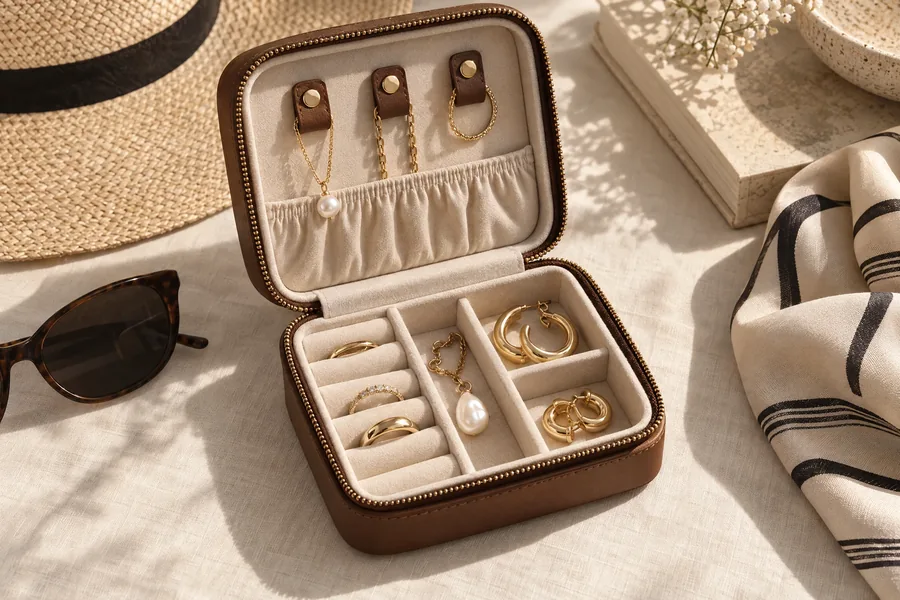
Travel introduces movement and pressure that a dresser drawer does not. Plan jewelry storage before packing clothes: choose a small selection, fasten chains and assign each item a separate cushioned compartment or pouch. A travel case should close without squeezing settings or bending pieces. Shake it gently while empty to check for loose dividers, then inspect how securely each compartment holds its contents without forcing them into place.
Keep necklaces separate even when a case has one large zipped pocket. Individual pouches can sit inside that pocket, provided pendants and clasps are not pressed against neighboring items. Pair earrings in a compartment with enough padding to prevent contact, and protect projecting posts from pressure. These jewelry storage ideas to prevent scratches and tangled chains work best when the packed case is not overfilled. If it bulges, take fewer pieces or use a larger case.
Place the case where hard objects will not crush it, and keep it apart from toiletries that could leak. Do not leave jewelry in a hot car or prolonged direct sunlight; some gems and organic materials are sensitive to light and heat. At your destination, establish a stable removal spot away from sinks and shower edges. Travel jewelry storage should remain a deliberate routine, not become a loose pile on a bathroom counter after the first evening.
Before departing, check every compartment against a simple written list or photo of what you packed. This is an organizational aid, not a guarantee against loss. When you return, unpack promptly and inspect clasps, links and settings before putting pieces back in their usual places. If something has snagged or shifted, adjust the travel layout next time. Effective jewelry storage improves through these small observations rather than through adding more pockets you do not actually need.
Explore our product collection for individual designs, photographs, and product details. When considering jewelry storage, look at each piece in the context of your own preferences and practical needs. Use the product description to check relevant specifications rather than relying on appearance alone. For a more personal recommendation or a question about a particular piece, contact katherine jewelry with the details that matter to you.