Editorial guidance only. Product characteristics, care needs, and commercial terms should be confirmed in writing for any specific item.
Choosing necklace length starts with your clothes, not a universal chart. The same chain can sit neatly inside one neckline and disappear against another, depending on the opening, fabric and pendant. This necklace length guide for different clothing necklines helps you judge that relationship with simple wardrobe tests rather than rigid styling rules.
First decide where you want the pendant to appear: against bare skin, over fabric or below a collar. Then consider its shape and how it moves. A small adjustment can give a familiar necklace a clearer place in an outfit without requiring a completely different jewelry style.
Find a clear landing place for each neckline
Before choosing a necklace length, put on the actual top and identify its strongest boundary: the edge of a crewneck, the point of a V or the curve of a scoop. Aim for either a visible gap between pendant and fabric or a deliberate placement over the garment. A pendant that repeatedly straddles the edge can look unsettled and slip inside the top. Neither skin nor fabric is automatically better; clarity is the useful starting point.
For a V-neck, try placing the pendant entirely inside the opening, with some breathing room above the lowest point. A narrow drop can echo the V, while a round pendant provides contrast. If you prefer wearing it over the fabric, extend the necklace length enough that the pendant sits clearly below the point rather than on it. Check from the side, too: the opening may look deeper head-on than it does during normal movement.
A scoop neckline gives you a curved space to work with. A short pendant can sit within that space, while a longer one can fall below the scoop onto the top. Compare necklace length with the depth of the opening rather than trying to trace the curve exactly. With a square neckline, a compact pendant centered above the horizontal edge often creates a simple focal point; a broad design needs more room between the straps.
For crewnecks and other closed tops, test two distinct options: above the collar or noticeably below it. A short necklace length works only if there is enough comfortable space at the neck. A longer pendant may be easier to see over a plain shirt, but check whether its chain catches under the collar. Thick ribbing and decorative edging deserve extra clearance because they already create a strong visual line.
With strapless or off-the-shoulder clothing, decide whether to emphasize the exposed upper area or draw attention farther down. Both are editorial choices, not requirements. Hold a ribbon at two possible drops and compare the complete silhouette. The necklace design concepts at katherine jewelry can offer visual starting points, but use your own neckline to determine necklace length; an illustration cannot predict where a pendant will land on you.
Balance pendant shape with collars, patterns and scale
A chain measurement does not tell the whole story because the pendant extends below it. A compact charm and a long drop on equal chains can have very different lowest points. When comparing necklace length, look at both where the chain settles and where the pendant ends. That distinction is especially useful with a shallow neckline, where a chain may fit inside the opening but its pendant reaches the fabric.
Start with the amount of quiet space available. A small, simple pendant can read clearly against bare skin or a plain blouse but become difficult to distinguish on a busy print. A broader silhouette might remain visible over patterned fabric, although it can compete with embroidery or ruffles. Before changing necklace length, try moving the focal point to a calmer part of the outfit. Sometimes the problem is background contrast rather than insufficient size.
An open collared shirt creates a frame, but the collar points and button placket introduce obstacles. Try the pendant within the opening and turn your shoulders to see whether the chain slides beneath either point. If the shirt is buttoned high, an over-shirt necklace can work when its outline remains distinct from the placket. Choose necklace length so the pendant does not repeatedly strike a prominent button or settle into the same narrow vertical line.
Pendant shape can either echo or interrupt the clothing. A vertical drop continues the direction of an open shirt or V-neck; a rounded motif softens those angles. Against a curved neckline, an angular piece creates a deliberate contrast. Browse sculptural design inspiration to compare strong outlines, not to infer materials or availability. For a fair comparison, test different shapes at the same drop before deciding whether one needs a longer chain.
Use the full outfit to judge scale. Jacket lapels, a patterned scarf and bold earrings may already frame the face, leaving little need for a large pendant. With a plain dress, the necklace can carry more attention. Adjust necklace length only after deciding which feature should lead. A useful test is to step back from the mirror: if the pendant and collar merge into one busy area, simplify the shape, change its landing point or remove another competing accessory.
Make layering work during an ordinary day
Layered clothing can change a successful placement as soon as you add a jacket or cardigan. Decide which garment should provide the pendant’s background, then assess necklace length with every layer on. A pendant intended to sit inside a blouse opening may vanish beneath lapels; one worn over a sweater may collide with a jacket fastening. Keep the focal point in a visible area rather than judging the chain against the innermost top alone.
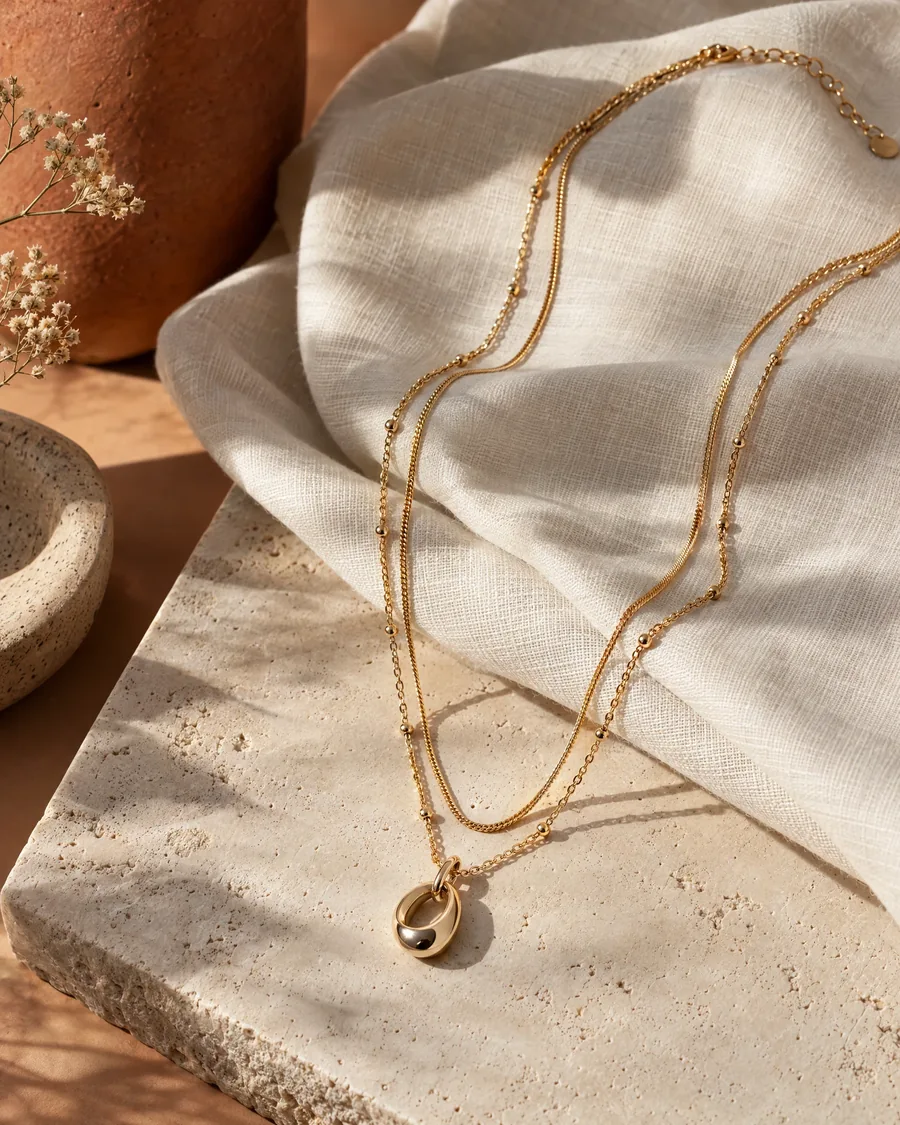
When layering necklaces, begin with two rather than several. Choose a shorter line and a lower focal pendant, leaving enough separation that their outlines remain distinct. There is no fixed gap that suits every design: a long pendant needs more clearance than a tiny charm. Test each necklace length separately first, then wear the pair together. If the pendants repeatedly overlap, adjust one drop instead of relying on constant repositioning throughout the day.
Consider how the fabric behaves. Loose knits and lace can catch projecting details, while a stiff collar may push a chain away from its intended position. Smooth fabric may allow a pendant to slide farther than expected. Examine the back and edges of your jewelry for anything that catches during a gentle try-on. If snagging occurs, choose another pairing rather than forcing it; the neckline match is not successful if you must keep rescuing the pendant.
Movement is the best check for everyday necklace length. Sit at a desk, lean forward, reach for a bag and put on your outer layer. Notice whether a long pendant contacts the desk or catches near a strap, and whether a shorter chain feels restrictive when you turn. For tasks where loose jewelry could catch, follow the relevant safety guidance and remove it. A pleasing mirror view should never take priority over comfortable, practical wear.
Build a small outfit record instead of memorizing rules. Photograph one necklace with a work shirt, a casual knit and a dress, then note which placement stays visible in each. If the necklace has an extender designed for it, record the setting you prefer; do not assume all chains are adjustable. You can also compare earring styling concepts to decide whether the necklace should be the main accent. This makes necklace length a repeatable wardrobe decision rather than a fresh puzzle every morning.
Measure, test and choose a placement you will actually wear
Use measurements to compare options, not to promise a particular landing point. Common chain lengths such as 16, 18 and 20 inches offer useful reference points, but neck circumference and body proportions change their appearance. To estimate necklace length, drape a flexible tape around the intended path without pulling it tight. Alternatively, mark a loose ribbon where its ends meet, remove it and measure it flat. Do not tie it tightly around your neck.
Account for pendant drop separately. If a chain forms the line you want but a pendant hangs below it, include that extra distance when checking clearance from the neckline. A ribbon approximates placement, not the drape of every chain: construction and weight influence the result. For a specific necklace length, ask whether the stated measurement includes the clasp and whether any extender is included or measured separately. Written dimensions are more useful than a style label alone.
Run a three-position comparison with one outfit. First place the pendant comfortably above the neckline, then near its edge, then clearly over the fabric. Take a straight-on photograph of each, keeping the camera position consistent. The edge position often reveals why a look feels crowded, while the other two show possible solutions. This necklace length guide is a starting method, not a requirement to select the same position for every garment or occasion.
Explore our product collection for individual designs, photographs, and product details. When considering necklace length, look at each piece in the context of your own preferences and practical needs. Use the product description to check relevant specifications rather than relying on appearance alone. For a more personal recommendation or a question about a particular piece, contact katherine jewelry with the details that matter to you.
Finish by checking comfort, visibility and movement together. Can you see the pendant without it fighting the collar? Does it stay reasonably settled when you sit and turn? Would you happily wear this arrangement for the intended occasion? If one answer is no, change the drop or simplify the styling. The most useful necklace length is not the one assigned to a neckline by a chart; it is the one that gives your pendant clear space and works with the clothes and activities of your day.