Editorial guidance only. Product characteristics, care needs, and commercial terms should be confirmed in writing for any specific item.
Getting ring size right is less about finding a magic number than understanding how a band behaves on your hand. It should feel secure during ordinary movement, pass over the knuckle with manageable resistance, and remain comfortable as your fingers change throughout the day. This guide explains how to estimate ring size before a professional fitting, using an existing ring or a simple measuring tool without treating either as a guarantee.
For readers exploring design ideas at katherine jewelry, the aim is practical preparation: gather reliable clues, recognize uncertainty, and know which questions to ask before committing to a particular fit.
Start with the Finger, Not the Number
Before measuring, choose the exact finger and hand where you intend to wear the ring. The corresponding finger on your other hand may not fit identically, so borrowing its measurement can create an avoidable error. Your preferred ring size also needs to suit the relationship between the knuckle and the finger’s base. A prominent knuckle can require enough room for passage while leaving extra space once the band settles into place. Note both areas rather than measuring whichever looks easiest.
Take readings under ordinary conditions, with your hands at a comfortable temperature. Avoid measuring immediately after exercise, a hot shower, exposure to cold, or any activity that leaves your fingers noticeably different from their usual state. Repeat the process at different times over several days. If your estimated ring size varies, keep the readings rather than averaging them into a falsely precise answer. The variation itself is useful information for a jeweler, especially if one reading would make the band difficult to remove.
Comfort and security are separate checks. A band that feels pleasant at rest may slide off too easily, while one that stays firmly in place may press uncomfortably when you make a fist. A suitable ring size generally allows the ring to move over the knuckle with some resistance without requiring force. Once it is on, try opening and closing your hand, bending your fingers, and holding a familiar object. Notice pressure, restricted movement, or excessive spinning rather than judging only its appearance.
Consider a reader whose borrowed ring turns freely at the finger’s base but catches at the knuckle. Choosing a smaller ring size solely to stop the turning could make removal harder. That situation deserves professional assessment of the finger shape and band design, not simply a smaller number. Do not force a ring onto a finger as a test. If a ring becomes stuck and your finger is painful, numb, or discolored, seek prompt help rather than continuing repeated attempts.
Record which hand and finger you measured, the time, the conditions, and any fit concerns. This short record makes a ring size estimate more useful than an isolated measurement. It also helps distinguish a recurring fit problem from an unusual day, giving the person performing your fitting a clearer starting point.
Use Home Measurements as Evidence, Not a Verdict
An existing ring is a useful starting point only if it fits the intended finger well. To estimate ring size from it, measure the inside diameter across the center, from inner edge to inner edge, excluding the metal. Use millimeters and a ruler you can read clearly. Check the measurement in more than one direction: a worn or distorted band may no longer be perfectly round. A ring that fits another person, another finger, or only in cold weather is weaker evidence.
If you do not have a suitable ring, a purpose-made measuring tool can help. Follow its instructions and check that its scale matches the sizing system you plan to use. A narrow strip of paper offers a rough fallback, but it can crease, shift, or tighten while you mark it. Wrap it around the finger without compressing the skin, mark the overlap, then measure the flat length. Treat the resulting ring size as a preliminary estimate, particularly if the measurement barely accommodates your knuckle.
Flexible string is often less reliable because it can stretch or sink into the skin. Even paper introduces error if it is unusually wide or pulled too firmly. Repeat a measurement from the beginning rather than merely checking the same mark. If several attempts produce noticeably different results, stop trying to extract a definitive ring size from the tool. Switch methods or bring the uncertainty to a professional fitting instead of selecting whichever reading matches your hopes.
Printed charts require an additional check: page scaling. A chart printed with a fit-to-page setting may alter the circles or ruler used for comparison. Follow the chart’s calibration instructions before placing a ring over any outline. Screenshots and images displayed on phones are not dependable measurement scales unless the tool provides a calibration process. When converting a diameter or circumference to ring size, use the relevant seller’s table rather than combining measurements from unrelated charts.
Keep the original measurement alongside the converted ring size and identify the system used. A bare number can be ambiguous because sizing conventions differ between markets. For example, a useful note says “inside diameter measured in millimeters, compared with this specific chart,” not simply “size confirmed.” The ring design concepts at katherine jewelry can help you identify the shapes you want to discuss, but imagery cannot establish dimensions or confirm a fit.
Match the Fit to Band Width and Design
Two rings carrying the same nominal measurement can feel different. A broad band covers more of the finger than a delicate one and may feel tighter, while the inner profile can change how the edges contact the skin. Your ring size estimate should therefore be tested with a measuring band reasonably similar to the intended design. Do not assume that a comfortable thin ring proves a wide band will fit equally well, or that a universal adjustment applies to every wider style.
Stacking changes the fitting problem, too. Several slim bands worn together occupy a broader area and may feel different from any one band alone. If you intend to wear a stack, test the combination rather than checking each piece separately. A ring size that works for an individual band may not provide comfortable movement across the full arrangement. Tell the fitter whether the rings will usually be worn together, occasionally separated, or moved between fingers; these are different practical requirements.
A top-heavy design presents another question: stability. A raised setting or substantial decorative top may rotate even when the band passes the knuckle correctly. Reducing ring size is not automatically the right remedy, because the smaller band could become uncomfortable or difficult to remove. Ask a qualified jeweler whether the design’s proportions and your finger shape are compatible. Any proposed fit modification should be assessed for that particular construction rather than treated as a standard home solution.
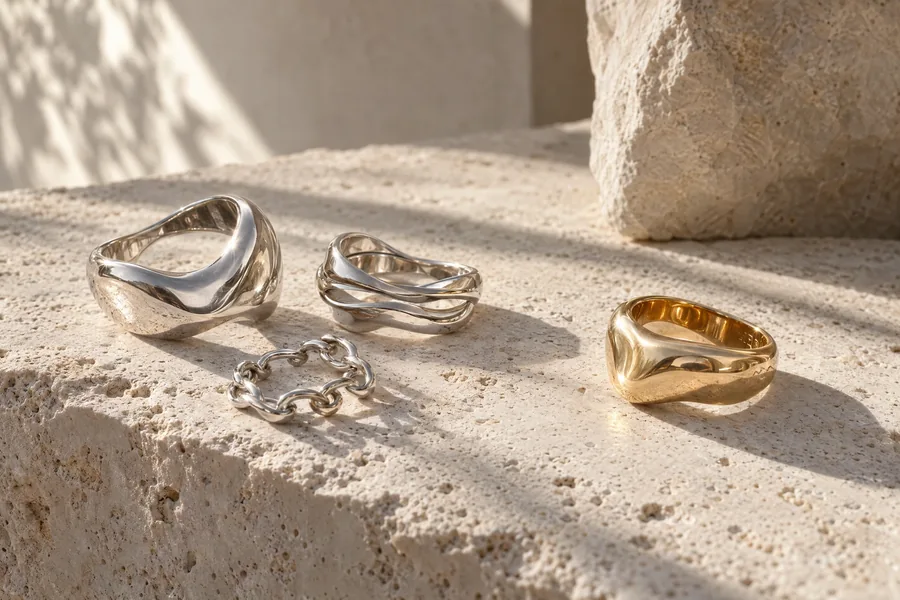
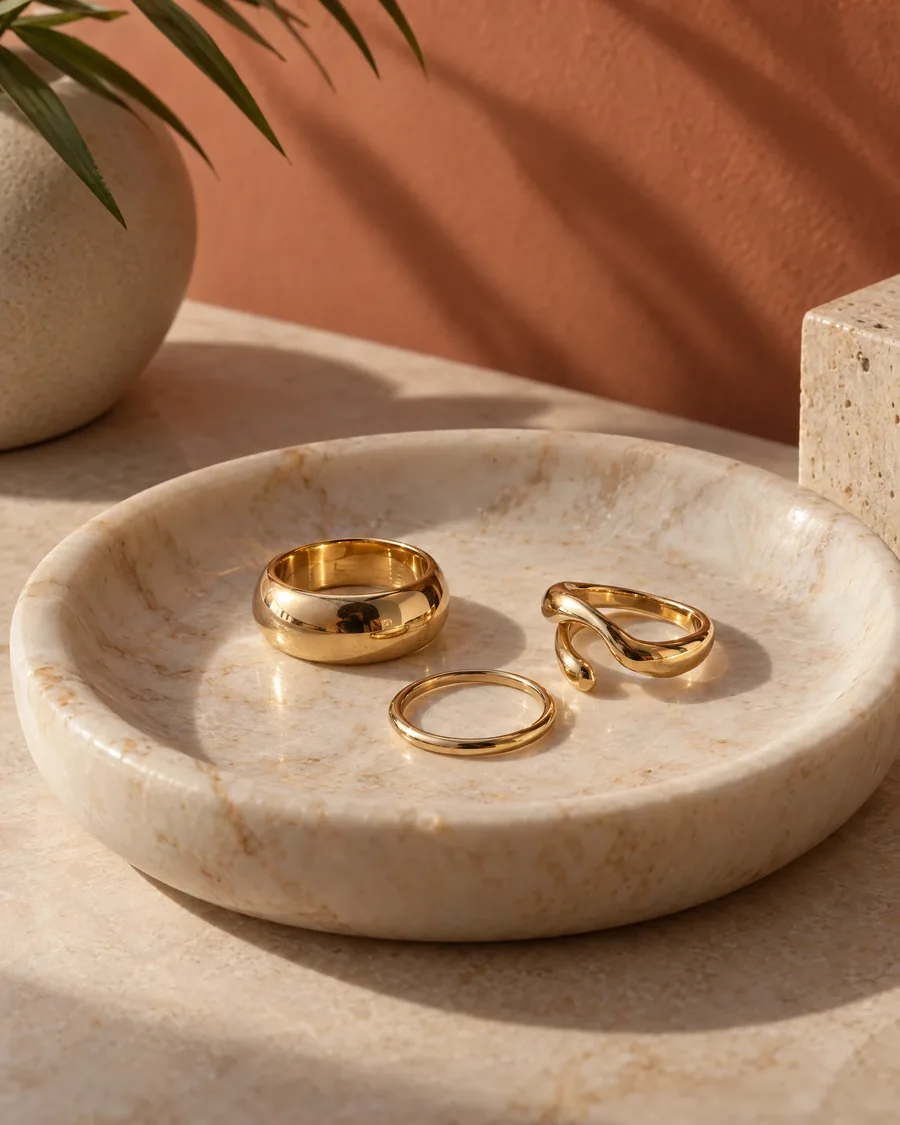
Explore the editorial jewelry concepts by silhouette: broad bands, open shapes, layered looks, or sculptural forms can help you describe your preferences. Images do not establish metal content, dimensions, flexibility, or whether a piece can be resized. Before relying on a ring size adjustment later, ask for written material and construction details. The FTC Jewelry Guides emphasize truthful descriptions; appearance alone is not a sound basis for identifying materials.
Resizing is not equally feasible for every design. Continuous patterns, stones around the band, coatings, and some constructions can complicate an alteration. An open-looking ring should not be assumed to be safely adjustable by repeated bending. Your final ring size decision should account for both present comfort and the options a qualified jeweler confirms are available. If a design cannot readily be altered, resolving uncertainty before purchase becomes especially important rather than a problem to leave for later.
Turn Your Estimate into a Confident Fitting
Bring your notes, the chart you used, and any well-fitting reference ring to a professional appointment. Explain the intended finger, typical wearing conditions, and whether you prefer a broad band or a stack. Describe what went wrong with previous rings: slipping, spinning, pressure, or difficult removal. These observations help the fitter interpret your ring size estimate. A useful fitting tests comfort and passage over the knuckle rather than merely assigning a number from the first measuring band you try.
Ask to compare nearby options where appropriate, ideally using gauges that resemble the planned band width. Give your hand a moment to relax between attempts, and do not repeatedly force a tight gauge over the knuckle. The best ring size is not necessarily the smallest one you can put on. Check ordinary hand movement and removal, then discuss any difference between the feel at the base and at the knuckle. If your fingers fluctuate substantially, ask whether a second fitting would be useful.
Before making a purchasing decision, confirm the sizing system, available measurements, and any applicable alteration or return terms in writing. Do not infer these from a photograph or a general educational guide. You can use the contact page to ask katherine jewelry what information is available for your inquiry; this article does not establish fitting appointments, merchandise availability, or resizing services. For a surprise gift, a recipient’s suitable existing ring offers a clue, but uncertainty about ring size should remain part of your planning.
Care habits matter once the fit is settled. Remove jewelry before swimming or household cleaning, and store pieces separately with cushioning to reduce scratches. The GIA jewelry care guidance explains that chemicals, heat, and unsuitable cleaning methods can harm jewelry; ultrasonic cleaning is not appropriate for every construction. If removal becomes persistently difficult, revisit ring size with a qualified jeweler rather than repeatedly tugging the band or improvising alterations. Uncertain materials also call for cautious, construction-specific care.
A good estimate leaves you with evidence, not false certainty: the right finger identified, repeatable measurements recorded, and the intended design clearly described. Professional fitting and the relevant seller’s sizing table should control the final decision. Treat ring size as a relationship between your hand and a particular band, not a permanent label. That approach makes it easier to choose comfortably, recognize when a fit needs reassessment, and avoid relying on a number that never suited the design.