Editorial guidance only. Product characteristics, care needs, and commercial terms should be confirmed in writing for any specific item.
Statement earrings can transform a familiar outfit, but bigger is not automatically better, and simpler clothing is not always necessary. What matters is the relationship between the earrings, the fabric near your face and the other details asking for attention. Learning how to style statement earrings without overwhelming an outfit starts with choosing a focal point, not banning every other accessory. A patterned shirt, sculptural jacket or colorful dress can still work beautifully with a bold pair. The practical approach is to assess shape first, organize color second and test the complete combination before deciding whether anything needs to change.
Read the silhouette before judging the size
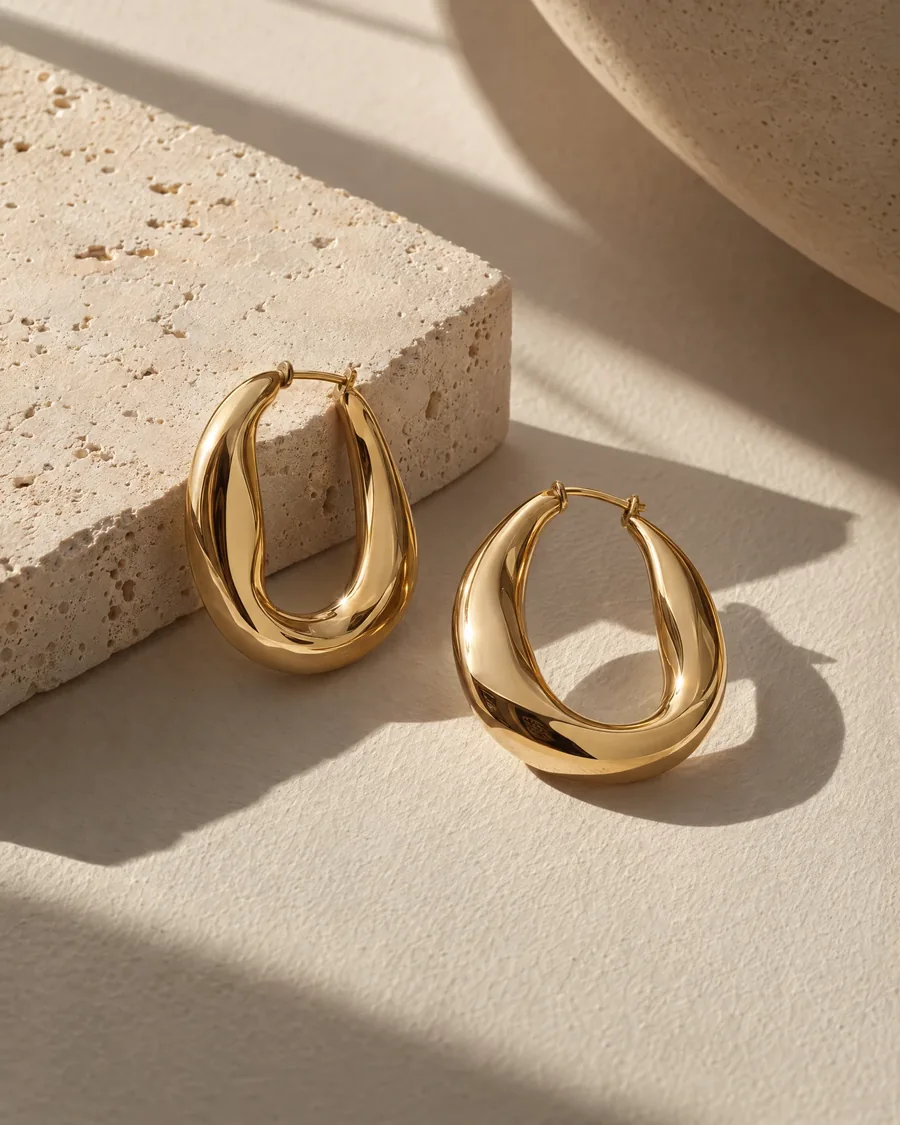
Two pairs with similar dimensions can have very different visual weight. A broad, filled-in disc creates a concentrated patch of detail, while an open hoop lets the background show through. A narrow drop extends the silhouette without necessarily occupying much width. When choosing statement earrings, look at their outline, open spaces and movement rather than treating length as the only measure of boldness. Hold them beside the outfit to see which feature registers first.
Next, notice where the widest part lands. Width beside the cheek feels different from width near the jaw or shoulder, especially when a collar or sleeve adds structure nearby. This is not a prescription based on face shape. Instead, compare two silhouettes with the same shirt: one broad and compact, the other longer and narrower. Choose the version that creates the amount of emphasis you actually want, rather than one that supposedly corrects your features.
Explore our product collection for individual designs, photographs, and product details. When considering statement earrings, look at each piece in the context of your own preferences and practical needs. Use the product description to check relevant specifications rather than relying on appearance alone. For a more personal recommendation or a question about a particular piece, contact katherine jewelry with the details that matter to you.
Hair changes the apparent scale, too. A pair partially hidden by loose hair may read as flashes of detail, while the same statement earrings become a stronger focal point with hair tucked behind the ears. Try your planned hairstyle before making the final choice. Turn your head and check whether the earrings disappear, overlap awkwardly with a hair accessory or catch in loose strands. A pair should work while you move, not only in a straight-on photograph.
For a concrete comparison, put on a white shirt and dark trousers, then test broad statement earrings against a slender drop. Photograph each from a few steps away using the same framing. The broad pair may supply a graphic accent; the drop may create a quieter vertical rhythm. Neither is inherently more balanced. Keep the statement earrings whose outline supports the look you intended, and use that comparison as a reference for similar outfits.
Give color and surface contrast separate jobs
Color balance begins with the garment nearest your face, not necessarily your shoes or bag. Decide whether the earrings will repeat a shade, introduce contrast or act as a quieter bridge between colors. Green statement earrings with a navy blouse, for example, can add distinction without requiring an exact match elsewhere. If the outfit already contains several colors, repeating one of them gives the earrings a clear connection to the clothing.
With a printed dress, examine the pattern from a distance. A small accent color can be a useful choice for statement earrings because it links the accessories to the print without copying its dominant shade. Alternatively, choose a neutral-looking pair and let shape supply the interest. Avoid assuming that a patterned outfit always needs tiny jewelry: a simple, bold outline can be easier to read against a busy print than a delicate, highly detailed design.
Surface contrast deserves its own check. Reflective statement earrings may look particularly prominent against a matte knit, while a less reflective design can provide contrast beside a glossy blouse. This is a visual observation, not a material identification: an image cannot establish what a metal or stone is. If material details matter to a purchase, ask for written information, consistent with the FTC's guidance on truthful jewelry descriptions.
For a bright accent, simplify selectively rather than removing all color. Suppose you want red statement earrings with a cream top and blue trousers. A quiet bag can leave those colors enough room, while a second vivid accessory near the face may shift the effect toward deliberate maximalism. Both approaches are valid. The useful decision is whether you want one clear accent or several equally assertive ones; accidental competition is what makes a combination harder to read.
Finish by checking the colors in lighting similar to your destination. Gem color appearance can vary with lighting and screens, so an online illustration is not a reliable promise of an exact match. If statement earrings carry the strongest color, a necklace can stay visually quieter without matching their outline. Explore the necklace design concepts for pairing ideas, but test position as well as color: even a restrained piece may feel busy when it sits directly beneath a detailed pair.
Use the neckline and the day's activities as filters
A neckline sets the available space around the earrings. An open neckline exposes more neck and shoulder, while a high neck provides a continuous fabric background. Neither demands a particular size. With a turtleneck, statement earrings can be the main decorative feature, especially if their outline is easy to distinguish against the fabric. With a low neckline, decide whether the open space should remain uncluttered or include a small supporting necklace.
Collars require a movement test rather than a still-image judgment. Put on the shirt, jacket and earrings together, then turn your head, look down and raise your shoulders gently. Long statement earrings may brush a stiff collar or become obscured by a lapel. If that happens, try a shorter shape, change the collar arrangement or choose a different layer. The aim is to solve the physical overlap instead of repeatedly adjusting the earrings throughout the day.
For a workday, consider what you will actually do. A commute with a scarf, frequent headset use or several clothing changes may make a compact design more convenient than a swinging drop. Wear the combination for a few minutes before leaving and notice pressure, snagging or distraction. Visual lightness does not tell you how heavy a pair feels. If earrings become uncomfortable, choose another pair rather than treating discomfort as the necessary cost of a finished look.
At a dinner or celebration, statement earrings can provide detail without a necklace, particularly when the dress has an interesting neckline. If the garment already features beading, ruffles or an asymmetric shoulder, test a simpler earring outline first. For a minimal dress, a more intricate design can supply the decorative focus. Keep the occasion in perspective: bold earrings are not automatically formal, and smaller ones are not automatically casual. Fabric, silhouette and the complete combination establish the mood.
Imagine taking a plain dark dress from an afternoon gathering to an evening meal. You might keep the clothing unchanged, put your hair back and replace a compact pair with statement earrings that have more movement. A bracelet can add detail farther from the face, leaving the neckline clear. The bracelet design inspiration offers ways to consider that distribution. Check the final look with any coat or wrap you will wear, so the styling works beyond the room where you got dressed.
Edit the complete outfit, not each piece in isolation
The final test is a full-length view. Put on your shoes, outer layer and any visible accessories, then step back from the mirror. Ask where your eye goes first and whether that matches your intention. If statement earrings are meant to lead, they should be easy to notice without every nearby detail demanding equal attention. If the dress is the focal point, the earrings can support it through a repeated color or a complementary shape.
When the outfit feels crowded, change one variable at a time. Remove the necklace, tuck away the scarf or replace the hair accessory, then look again. Changing several things at once makes it difficult to understand what helped. You may find that statement earrings work perfectly once a necklace is removed, while the print and bright bag can stay. Balance does not require stripping an outfit down to neutrals; it requires making the visual relationships legible.
Use a three-version comparison when you feel stuck: the outfit without earrings, with the chosen pair and with a quieter alternative. Keep your hair and clothing arrangement consistent. If statement earrings add a clear point of interest, they are doing useful work. If the quieter pair lets a special collar or intricate print show more clearly, save the bold pair for another combination. This exercise helps separate liking an individual accessory from liking it with this particular outfit.
Photographs can reveal overall proportions, but they are only one check. Look in a mirror, move around and consider how the combination feels during ordinary activities. For design exploration, the earring concept collection can help you compare visual directions. Questions about katherine jewelry's website or illustrated concepts belong on the contact page; images alone should not be treated as evidence of specifications or availability. Your styling decision still benefits from seeing and trying the actual pieces involved.
Knowing how to style statement earrings without overwhelming an outfit ultimately comes down to choosing emphasis and testing the result. Start with an outline that works beside your clothing, give color a deliberate role and check that the pair suits your movements and layers. Then edit only what competes unnecessarily. Statement earrings do not need to be the only interesting element in a look. They need a clear relationship with the others, leaving you with an outfit that feels expressive, comfortable and recognizably your own.