Editorial guidance only. Product characteristics, care needs, and commercial terms should be confirmed in writing for any specific item.
Sterling silver appears on jewelry labels, care guides, and gift descriptions, but the words do not tell the whole story. Understanding what sterling silver means in jewelry material descriptions starts with the alloy itself, then moves to any coatings, settings, and stones that may be part of the piece. Those details affect appearance, care, and how confidently you can compare items. This guide explains how to read the terminology, what to ask when a listing is vague, and how to make everyday care decisions without relying on appearance alone.
These are general material guidelines, not claims about any particular item shown or offered by katherine jewelry. A written description is the best starting point; when details matter, ask for them directly.
What the word sterling tells you
Sterling silver is an alloy normally described as 92.5% silver, with other metal making up the remainder. The alloy is used because pure silver is relatively soft for many jewelry applications. The familiar “925” mark refers to that silver proportion, but a mark alone is not a full account of an item’s construction or a guarantee that every part is sterling. A clasp, chain, decorative element, or setting may have different material details, so look for language that describes the piece as a whole.
When a description says “sterling silver,” read it as a claim about metal composition, not a promise about color, weight, finish, or performance. A polished surface can look bright, while a deliberately darkened finish can look quite different; neither appearance establishes the underlying metal. Sterling silver may also tarnish over time. Tarnish is a surface change, and its rate can vary with storage, surroundings, and use. It does not by itself tell you whether a piece is genuine or how much silver it contains.
For a practical reading exercise, compare two listings for similar earrings. One might say “sterling silver posts”; another might describe the entire earring as sterling silver. Those statements are not equivalent: the first specifies the posts, while leaving the rest unclear. If you need the full material breakdown, ask what the body, posts, backs, and any other metal components are made of. The FTC Jewelry Guides explain the importance of truthful, clear representations of jewelry materials.
Make a short checklist before comparing options: Is the metal named for the whole piece or one component? Is a 925 mark mentioned, and where? Does the description identify other metals or finishes? This keeps a familiar label from doing more work than it should. For examples of design categories, explore the earrings collection concept or necklace collection concept; those pages are inspiration, not a substitute for item-specific material information.
Read plating and finish language carefully
One important distinction is whether silver describes the metal throughout or only a surface layer. Plating places a coating over a different underlying material; it is not the same as an item made of sterling silver throughout. Descriptions may use terms such as “silver plated,” “silver-tone,” or “sterling silver with a plated finish.” These phrases communicate different things, and broad wording can leave the base metal or coating unspecified. Ask for clarification rather than treating every use of “silver” as a composition claim.
Consider a buyer choosing a ring for frequent wear. A sterling silver description may answer the question of the main alloy, but it does not necessarily explain whether a colored surface treatment is present, what the inside of the band is made from, or how the finish should be cared for. Ask whether the piece is plated, what material lies beneath the plating, and whether the stated metal applies to the band and setting. A seller’s written reply gives you a clearer basis for comparing descriptions later.
Finish and construction also affect how a piece may age. A coating can wear with friction or repeated contact, while an uncoated metal may develop its own surface changes. Neither outcome can be predicted from a product photo alone. A screen, lighting, and image processing can alter the apparent color, and a polished finish may reflect its surroundings. Treat a photograph as a style reference, not proof of metal identity. The same caution applies when comparing a silver-colored piece with sterling silver: resemblance is not material evidence.
If an online description leaves room for interpretation, ask specific questions before relying on it: What is the base metal? Is any part plated or coated? Does the stated sterling silver include the chain, clasp, posts, or setting? These questions are useful whether you are browsing the ring collection concept or considering another style. At katherine jewelry, collection pages are editorial design concepts; for any actual item, rely on its written material details rather than inferring composition from an image or category name.
Match care to the complete piece
Care begins with the whole construction, not just the metal label. Sterling silver can tarnish, but a piece may also include gemstones, pearls, adhesives, coatings, or delicate settings that need different treatment. Before cleaning, identify what is present and check any care directions supplied with the item. If the materials or treatments are uncertain, avoid experimenting with abrasive cloths, dips, or household recipes. A qualified jeweler can assess whether a particular cleaning method is suitable.
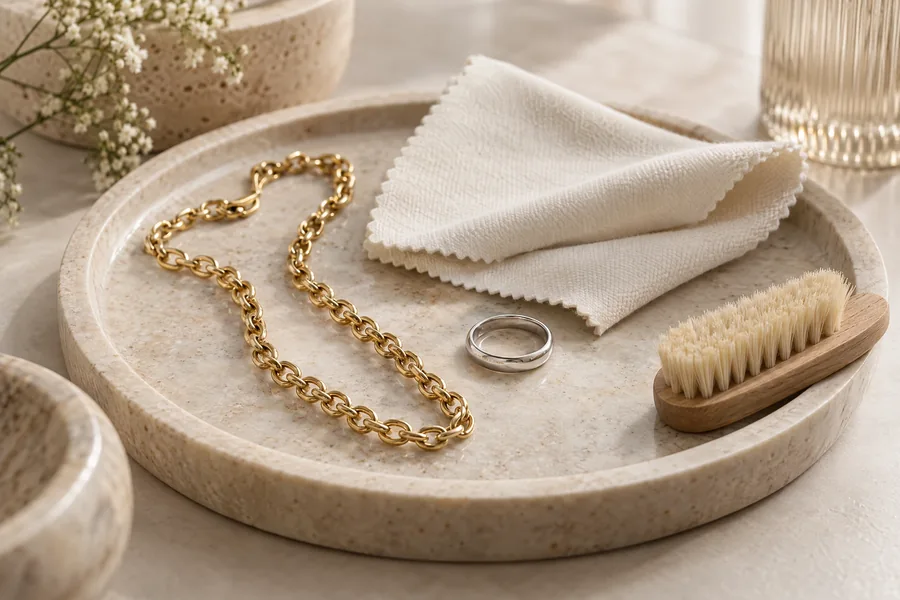
For routine habits, remove jewelry before swimming and household cleaning, and avoid exposing it to cosmetics or household chemicals where practical. When you take it off, store it dry and separately padded so pieces do not rub against one another. Anti-tarnish storage can help limit tarnish on sterling silver. A small compartment or soft pouch can also reduce tangling and scratching, especially when chains or several pieces share a drawer. For travel, use separate cushioned compartments rather than letting jewelry move loose together.
Do not assume that an ultrasonic cleaner is safe just because a metal is described as sterling silver. Vibration can loosen settings, and pearls, organic materials, surface-filled stones, and many temperature-sensitive gems require caution. Even stones that tolerate mild cleaning do not make every complete piece suitable for an ultrasonic device. The GIA jewelry care guidance emphasizes that care depends on gemstones and construction. If you cannot identify a stone or treatment, ask a jeweler instead of testing a machine or strong cleaner at home.
Storage should suit the other materials too. Pearls and opals should not be kept in excessively dry environments, while direct heat and sudden temperature changes may harm some gems and organic materials. That means one storage routine may not fit every item in a collection. Keep a note of any special instructions and separate pieces with different needs. Sterling silver is only one part of the care decision; the safest routine takes account of every material, finish, and setting in the jewelry.
Ask better questions before choosing
A useful material description lets you compare like with like. When you are considering a piece, look for the stated metal, whether the description applies to the whole item, and any mention of plating or other finishes. If gemstones are included, check how they are identified and whether treatments are disclosed. Terms such as natural, cultured, lab-created, and imitation have different meanings; they should not be treated as interchangeable. The FTC’s guidance calls for jewelry claims about metal, stones, and treatments to be represented truthfully.
For example, imagine comparing two necklaces that appear nearly identical. One listing names sterling silver for the chain and clasp, while the other simply says “silver-colored.” The second phrase describes appearance, not necessarily composition. Ask what the underlying metal is and whether a coating is involved. If a stone is included, ask for its correct identity rather than assuming from color or sparkle. These questions do not require specialist knowledge; they help the seller provide details that make a fair comparison possible.
Request important answers in writing, especially when the metal content, gemstone identity, treatment, or care method would affect your decision. A general article can explain terminology, but it cannot verify a particular item. If written details are missing or inconsistent, pause rather than filling the gaps with assumptions based on a photograph, a stamp, or the word “silver.” For broader background on the site, the about page provides brand context, while the contact page is the appropriate place to ask item-specific questions.
The simplest rule is to separate three questions: What is the metal? Is it coated or otherwise finished? What other materials change how the piece should be handled? Sterling silver answers only the first question when the description clearly applies to the relevant parts. Read the wording, confirm uncertainties, and choose care based on the complete construction. That approach makes material labels more useful—and helps you make a considered decision without mistaking a familiar name or attractive finish for proof of what a piece contains.