Editorial guidance only. Product characteristics, care needs, and commercial terms should be confirmed in writing for any specific item.
The appeal of ultrasonic cleaners is easy to understand: a small machine promises to reach the grime that a cloth cannot. Yet jewelry is rarely a single, uncomplicated material. One ring may combine a gemstone, a treatment, a metal finish, and a setting that has changed through years of wear. Are ultrasonic cleaners safe for all jewelry materials? No—and appearance alone cannot tell you which pieces are suitable. This katherine jewelry guide explains how to assess the whole object, recognize reasons to pause, and choose a gentler approach when its materials or condition are uncertain.
Understand the Cleaning Action—and Its Limits
An ultrasonic bath uses high-frequency sound waves to create tiny bubbles in a liquid. As those bubbles collapse, they produce a cleaning action that can dislodge residue from small spaces. That explains why ultrasonic cleaners can be useful for certain jewelry, but it also explains their limits: the action reaches delicate joins and vulnerable surfaces as well as dirt. A machine does not distinguish between unwanted buildup and a fragile component.
Think of suitability as a chain with several links: the stone, any treatment, the metal or coating, the setting, and the item's current condition. Every link needs to tolerate the process. A durable gemstone does not automatically make its surrounding jewelry suitable for ultrasonic cleaners. Nor does a substantial-looking metal setting prove that its prongs are secure. The least tolerant component should control the care decision for the entire piece.
Heat and cleaning solution add separate variables. Some machines warm the bath during use, while others offer a heating feature. An unsuitable liquid can introduce chemical damage even when vibration is not the main concern. Instructions for ultrasonic cleaners describe how to operate the appliance; they do not establish that an unidentified pendant can withstand it. Read the equipment instructions, but obtain jewelry-specific guidance before treating those instructions as permission.
For example, imagine two visually similar clear-stone rings. One has documented materials and a recently inspected setting; the other is inherited, with no treatment information and a prong that catches on fabric. Their matching appearance does not justify matching care. Before considering ultrasonic cleaners, set the inherited ring aside for identification and inspection. Avoid testing it in the bath to discover whether it is durable: damage may not be reversible.
The GIA guidance on caring for jewelry emphasizes that ultrasonic cleaners are not universally safe and that vibration can loosen stones. Turn that warning into a practical rule: seek an assessment of the actual piece, not a general statement about its gemstone family. Ask whether the stone, treatment, setting, finish, solution, and temperature are compatible. A clear answer should address the complete construction rather than only the most prominent material.
Identify Materials and Treatments Before Choosing a Method
Start with what you can document, rather than what you can guess. Gather receipts, written descriptions, appraisal information, or care instructions, noting any gaps. Words such as “gold-colored” or “pearl-like” describe appearance, not composition. The FTC Jewelry Guides reinforce the importance of accurate material and treatment descriptions. For ultrasonic cleaners, missing information is a reason to pause, especially when an item combines several stones or has an unfamiliar surface finish.
Pearls and other organic materials warrant particular caution. They should not be treated as though they were durable faceted gemstones simply because they sit in metal jewelry. A pearl necklace also introduces questions about its stringing and attachments. If you are browsing pearl-inspired design concepts, remember that images are not material documentation. Keep pieces described as pearls out of ultrasonic cleaners, and ask for appropriate care instructions rather than improvising a machine cycle.
Gemstone treatments can change the answer even when the underlying material sounds familiar. Surface-filled stones are a particular concern, and other treatments may require restricted cleaning methods. A label that identifies only the gemstone may therefore be incomplete for care purposes. Before using ultrasonic cleaners, ask whether the stone is treated and whether that specific treatment tolerates the process. If nobody can confirm the treatment status, choose professional assessment instead of assuming that silence means untreated.
Opals and numerous temperature-sensitive gemstones also need cautious, material-specific care. Hardness is not a complete cleaning guide: resistance to scratching does not establish resistance to heat, sudden temperature changes, chemicals, or vibration. A mixed-stone bracelet makes this especially important. Even if most stones would tolerate ultrasonic cleaners, one vulnerable element can rule out the process for the whole bracelet. Do not average the risks across its components or rely on the largest stone.
Metal descriptions need equal attention. Sterling silver is normally an alloy containing 92.5% silver, while plating describes a surface layer rather than solid metal throughout. Neither a color nor a stamp, considered alone, explains every coating, repair, or decorative addition. For ultrasonic cleaners, obtain guidance that includes those details. A useful written care note names the materials and treatments, identifies any restrictions, and explains an alternative method when machine cleaning is unsuitable.
Check Condition: A Suitable Material Can Still Be a Risky Piece
Material identification is only the first gate. Daily wear can bend prongs, thin connections, or leave a stone less secure than it once was. Before considering ultrasonic cleaners, examine the piece under good light without pressing or pulling its components. Look for an uneven setting, a missing stone, a bent clasp, or a visible crack. An inspection at home can flag a problem, but it cannot certify structural safety.
Pay attention to changes you have already noticed while wearing the jewelry. A ring that now catches on a sweater, a pendant that rattles, or an earring with a shifting stone deserves professional attention before cleaning. Do not deliberately shake it to confirm the symptom. Vibration from ultrasonic cleaners may aggravate a compromised setting. Cleaning is not a repair, and removing grime will not restore a prong's shape or secure a loosened connection.
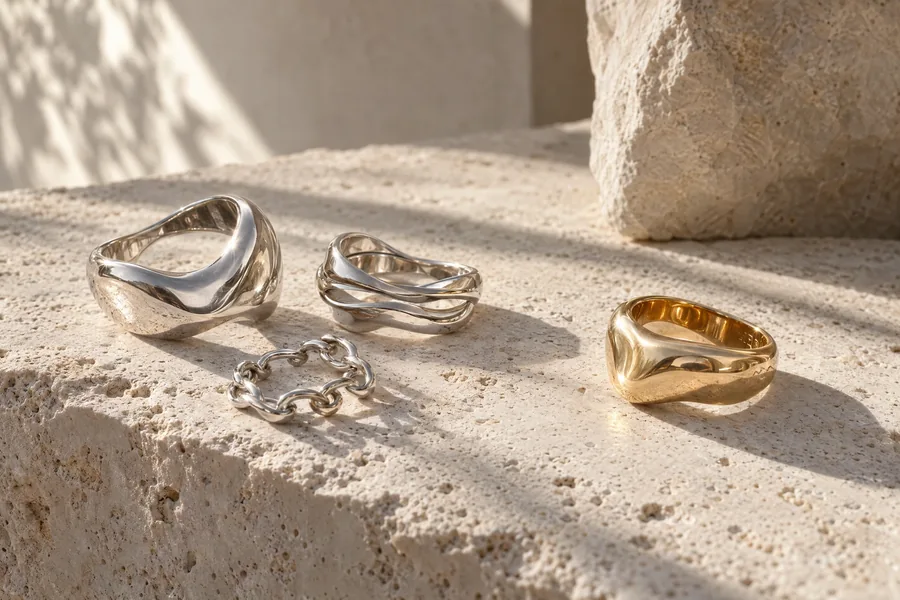
Construction creates risks that may be easy to overlook. Glued components, layered decorative elements, and previously repaired joins need individual evaluation; their compatibility cannot be inferred from the main metal. When exploring ring design inspiration, intricate silhouettes can help you recognize how many separate details a piece may contain. Whether a design looks simple or elaborate, ultrasonic cleaners require a judgment about the real item's assembly, not the visual concept.
Consider a pair of earrings with small stones and narrow posts. One has been repaired, while the other has not. Even if both originally shared the same materials, the repair may change the care decision. Tell the jeweler about it and mention any adhesive or replaced component you know of. Ask whether both earrings remain appropriate for ultrasonic cleaners; do not assume that approval for one automatically covers its partner or an entire matching set.
If a professional confirms suitability, follow the specific solution, temperature, and duration guidance given for that piece, alongside the machine's operating instructions. Do not mix unknown jewelry into the same session or improvise stronger chemicals to speed up results. After using ultrasonic cleaners, check that every stone is present and inspect the setting without force. If anything appears shifted or feels different, stop wearing the item and arrange an inspection rather than another cleaning cycle.
Build a Gentler Routine When the Answer Is Uncertain
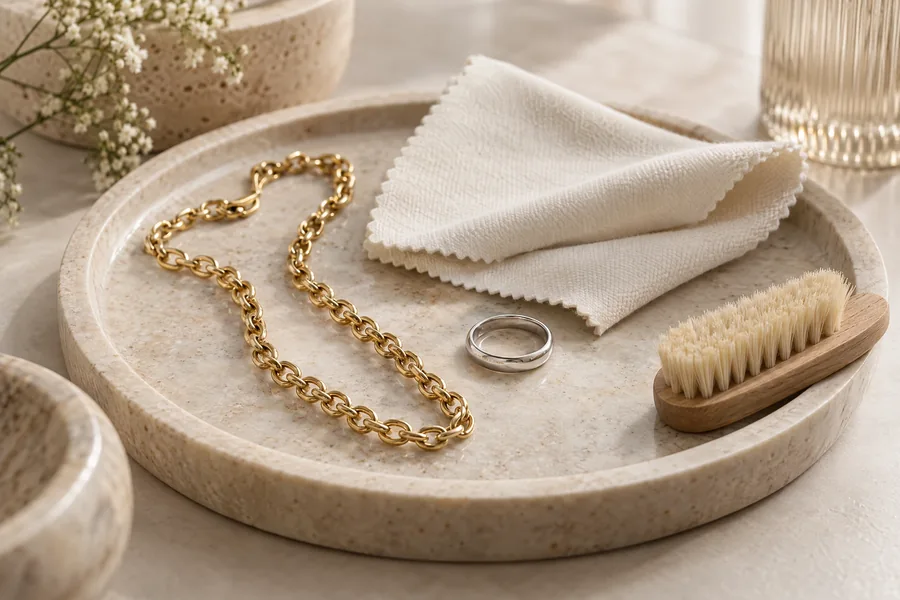
When the answer is uncertain, postponing a deep clean is usually more sensible than escalating it. A soft, nonabrasive cloth can remove some surface residue from many pieces, but even wiping should be gentle around loose stones, delicate finishes, and fragile materials. Avoid rubbing grit into the surface. Treat ultrasonic cleaners as an optional method with eligibility requirements, not the default next step whenever ordinary wiping leaves something behind.
For many durable, securely set pieces, mild cleaning may be appropriate, but confirm the method first. Ask whether lukewarm water, a small amount of mild soap, and a soft brush are suitable, and whether soaking is allowed. Some constructions need a different approach. Keep pearls, unknown treatments, vulnerable finishes, and uncertain attachments out of a generic soaking routine. A safer alternative to ultrasonic cleaners still needs to suit the complete object, not merely seem gentle.
Preventive habits reduce the need for intensive cleaning. Remove jewelry before swimming or household cleaning, and avoid exposing it to cosmetics and household chemicals. Store items separately with soft padding so that they do not scratch one another. Sterling silver benefits from anti-tarnish storage, while pearls and opals should not be kept in excessively dry conditions. These habits cannot eliminate every care problem, but they can make frequent reliance on ultrasonic cleaners less tempting.
Explore our product collection for individual designs, photographs, and product details. When considering ultrasonic cleaners, look at each piece in the context of your own preferences and practical needs. Use the product description to check relevant specifications rather than relying on appearance alone. For a more personal recommendation or a question about a particular piece, contact katherine jewelry with the details that matter to you.
A useful final rule is simple: identify, inspect, then choose. If materials or treatments are unknown, seek clarification; if a setting seems compromised, arrange repair assessment; if the complete piece has been approved, follow its specific instructions. Otherwise, stay with the recommended gentler method. Ultrasonic cleaners can serve suitable jewelry, but a polished appearance is never worth gambling with an irreplaceable item. Individual care means letting the piece's needs—not the convenience of the machine—determine what happens next.